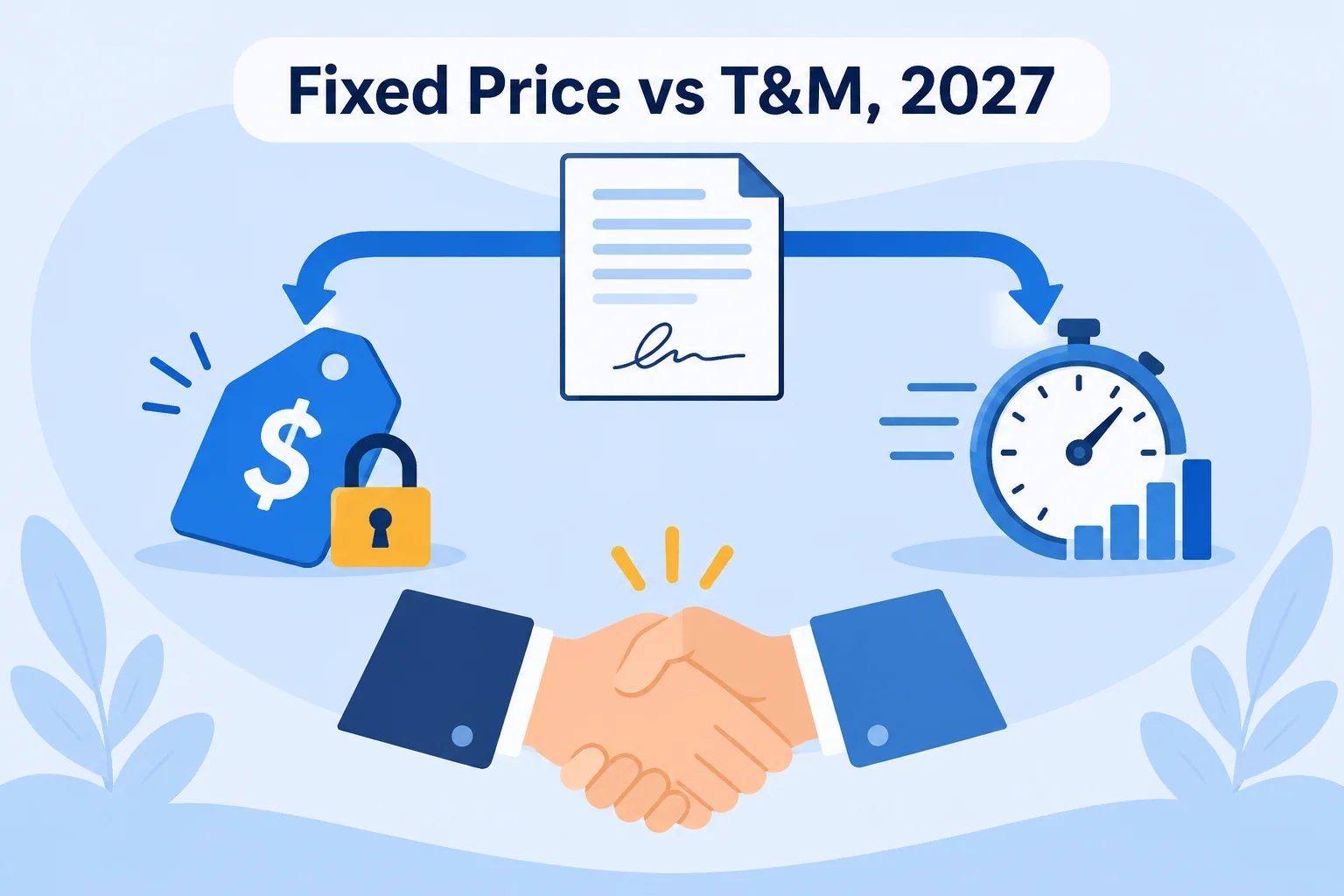
Fixed price fits small, precisely defined projects where scope will not change; time and materials fits work still being discovered, which is most software. Fixed price caps your spend but charges for that certainty through padding and change orders. The pattern that serves most founders best: a fixed-price discovery phase, then time and materials with caps and milestones.
The contract model gets chosen in the least informed week of the whole project, usually by comparing two proposals built on different assumptions, and it quietly decides how every disagreement for the next six months will go. We sell under both models, so we have watched each one succeed and each one curdle, and the honest pattern is that the model matters less than whether it matches your scope’s maturity. This guide explains who actually carries the risk in each structure, the failure modes vendors do not advertise, and the hybrid that most experienced buyers, and most honest vendors, converge on.
What Do Fixed Price and Time and Materials Actually Mean?
A fixed-price contract sells you an outcome: a defined scope for a defined sum, with the vendor absorbing overruns. A time and materials contract (T&M) sells you capacity: you pay for the hours worked at agreed rates, and the spend follows the work wherever the project actually goes.
The textbook framing says fixed price puts risk on the vendor and T&M puts it on you, and the textbook framing is why founders instinctively prefer fixed price. The practical truth is less flattering to both models. A fixed-price vendor prices the risk into the quote, which means you pay an insurance premium whether or not anything goes wrong, and the scope document becomes a legal boundary that every change must cross through paid change orders. A T&M vendor carries almost no price risk, which means the discipline that protects your budget, estimates, caps, and milestones, has to be written in rather than assumed.
Both models are honest tools. Fixed price is a bet that the scope is truly known; T&M is an admission that it is not. The expensive mistakes come from mismatches: fixed price wrapped around a vague idea, or open-ended T&M handed to a team nobody is managing.
Fixed Price vs Time and Materials: How Do They Compare?
| Factor | Fixed price | Time and materials |
|---|---|---|
| What you buy | A defined outcome | Capacity and skill, applied as needed |
| Price risk sits with | Vendor (priced into the quote) | You (managed by caps and reviews) |
| Scope changes | Change orders, each priced and negotiated | Absorbed in flow, reprioritized weekly |
| Vendor’s incentive | Finish inside budget, resist additions | Keep you satisfied enough to continue |
| Your effort | Heavy up front (perfect specification) | Steady throughout (priorities and reviews) |
| Transparency | Price known, internals opaque | Internals visible, total emergent |
| Quality pressure | Squeezed when the vendor misestimated | Protected, but paced by your attention |
| Best for | Small, precisely specified, stable scope | Evolving products, discovery, long builds |
The row founders underweight is the vendor-incentive one. Under fixed price, every hour saved is vendor profit, which pulls quietly against thoroughness exactly when the budget gets tight; under T&M, every hour is billed, which pulls toward gold-plating unless milestones keep the work pointed at outcomes. Neither pull makes vendors villains. Both make contract structure do the work that good intentions cannot.
When Does Fixed Price Work Best?
Fixed price earns its premium when three things are simultaneously true: the scope is genuinely specified, the work is well-trodden, and the project is short. A marketing site from finished designs, a defined integration, a migration with a clear endpoint, a discovery phase itself: these are fixed-price shaped, because the unknowns are small enough for a vendor to price without padding the quote into fiction.
It also fits organizations that structurally cannot do variable spend: grant-funded projects, procurement departments that approve a number once, budgets that need a signature from someone who will not be in the weekly meetings. Paying the certainty premium is rational when certainty is what your organization actually requires.
The failure modes are just as specific. Fixed price around vague scope produces the padded quote, and then the change-order treadmill, where the real price emerges one negotiation at a time and the relationship sours on schedule. Worse is the quiet version: a vendor who misestimated and cannot charge more starts saving hours where you cannot see it, in testing, error handling, and documentation, and the corners cut surface after launch as the maintenance bill nobody budgeted. When a fixed bid lands far below the others, the discount is usually being financed by one of those two futures, which is the same vetting logic we laid out in hiring app developers: interrogate the cheap bid’s missing rows.
One more boundary worth drawing: fixed price does not get safer by making the specification enormous. Past a certain scope, the specification itself becomes the fiction, because no founder can fully describe a product they have not seen users touch. That is not a documentation failure; it is the nature of building something new, and it is the argument for the next section.
When Does Time and Materials Work Best?
T&M fits any project where learning is part of the work, which covers most real product development. New products before product-market fit, builds with evolving scope, long engagements where priorities will shift, and anything where you want this week’s user feedback changing next week’s work: these run better when the contract does not tax every adjustment.
The model’s advertised weakness, the open meter, is real and manageable. Managed T&M looks like this: estimates per feature before work starts, a monthly cap or budget ceiling in the contract, weekly demos against a milestone plan, and the right to pause or stop with defined notice. Under that structure the meter anxiety mostly evaporates, because you can see what every week bought and stop the moment value stops. Unmanaged T&M, no estimates, no caps, no demos, deserves its reputation, and we decline to work that way for the same reason you should decline to buy that way: nobody benefits from a project with no scoreboard.
The buyer’s obligation under T&M is attention. The model converts your weekly priority calls into budget control, which is precisely why it rewards founders who did the planning homework, the written scope, the phased feature list, the named decision-maker, from our guide on how to plan a software project. A T&M contract in the hands of a prepared buyer is the cheapest way to build evolving software; in the hands of an absent one, it is a subscription to drift.
Industry practice has been drifting toward structured flexibility for years: Deloitte’s Global Outsourcing Survey found outcome-based arrangements growing alongside traditional models, with skilled talent and agility joining cost among the primary drivers of external engagements. The market is converging on the same lesson founders learn individually: pay for outcomes where outcomes can be defined, pay for capacity where they cannot, and write the discipline into either.
What About the Hybrid: Fixed Discovery, Then T&M?
The pattern most experienced buyers converge on splits the project at the point where certainty changes: a fixed-price discovery and design phase first, then time and materials development under caps and milestones. Discovery is small, definable, and identical in shape across projects, so fixing its price is honest; development is where the unknowns live, so flexible structure fits. This is not a neutral observation on our part: it is how most projects at SoftwareOrbits actually run, as our development process lays out, because after enough projects under both pure models, the hybrid is simply what kept working.
The hybrid’s quiet advantage is informational. Discovery produces the validated scope, the milestone plan, and real estimates, which means you enter the T&M phase with the two things that make T&M safe: a plan to measure against and a vendor you have already worked with once at low stakes. If discovery goes badly, you exit for the cost of discovery, with the plan as a deliverable you keep, and shop the build elsewhere. The fixed-price version of that exit costs a lawsuit.
One practical note on pricing the discovery phase itself: expect a few thousand dollars fixed, two to four weeks, and a deliverable package, scope, estimates, milestone plan, that is explicitly yours whichever vendor builds afterward. A vendor who prices discovery high enough to feel like commitment, or whose discovery output is unusable by anyone else, has converted a de-risking phase back into lock-in, which defeats its purpose.
Variants exist for different risk appetites. Milestone-based fixed pricing, a fixed price per phase, re-quoted as each phase clarifies the next, suits buyers who need number-certainty but accept re-pricing points. Capped T&M, time and materials with a not-to-exceed ceiling per month or milestone, suits buyers who want flexibility with a hard floor under the downside. Both are closer to the hybrid than to either pure model, which is rather the point: the mature versions of fixed price and T&M converge.
A Worked Example: The Same Project Under Three Contracts
Take a realistic case: a booking product scoped at roughly $80,000 and four months, which, like most first builds, discovers two meaningful scope changes along the way, one feature cut, one unplanned integration added. Here is how the same project plays out under each structure, based on the patterns we see repeatedly:
| Fixed price | Pure T&M | Fixed discovery + capped T&M | |
|---|---|---|---|
| Contract price at signing | $95K (scope padded for risk) | Rate card, no total | $9K discovery, then estimates |
| The added integration | $12K change order, two weeks of negotiation | Absorbed, ~$8K of logged hours | Absorbed under cap, re-planned at milestone |
| The cut feature | No refund; already priced in | Never built, never billed | Never built, never billed |
| Likely total | $107K | $78K–$88K, if managed | $80K–$90K |
| Relationship at launch | Strained by the change order | Healthy if demos held; drifting if not | Healthy, with a plan both sides trust |
The numbers are illustrative, but the shape is not: fixed price charges for the risk twice, once in padding and once in the change order, while refunding nothing for the scope that shrank. The managed structures track the work that actually happened. The one scenario where the fixed-price column wins is the project with zero changes, and in a decade of builds we have met that project only when the scope was tiny or the discovery was already done.
How Do You Protect Yourself in Either Contract?
Six clauses do most of the protecting, whichever model you sign:
- IP assignment on payment. Everything created belongs to you as it is paid for, with code in repositories you control from day one. Model-independent and non-negotiable.
- Milestones with demonstrable output. Money, under either model, releases against working software you can click, not calendar dates or status reports. This single clause converts both models’ incentives toward shipping.
- Estimates and a change log, even under T&M. Per-feature estimates before work starts, and a written record when actuals diverge. Under fixed price, the same clause governs change orders: priced in writing before work proceeds.
- A cap and a conversation trigger. Under T&M, a monthly ceiling; under fixed price, a defined process for what happens at 120% of any estimate. The point is not the number; it is that overruns trigger a conversation instead of a surprise.
- Exit terms both sides can live with. Defined notice, you keep everything paid for, and handover obligations, documentation, credentials, repo access, spelled out. A contract you can leave calmly is a contract nobody has to leave.
- Warranty and defect handling. Who fixes post-delivery bugs and for how long, so the fixed-price vendor’s quality squeeze and the T&M vendor’s meter both have a backstop.
Notice that the list is really one principle applied six ways: make the invisible visible, in writing, before anyone is upset, because every contract dispute we have ever been shown started as an ambiguity someone decided not to price. The vendors worth hiring agree to all six without friction, under either model, and that agreement is itself a vetting signal, the same one our guide on how to choose a software development company files under pricing-model red flags.
When Is the Contract Model Itself a Red Flag?
Sometimes the proposal’s structure tells you more than its number. A vendor pushing hard for fixed price on a scope you both know is vague is pricing the fog, and the quote contains either padding you cannot see or change orders you cannot yet count; confident certainty about an uncertain thing is salesmanship, not estimation. The mirror image is the vendor who insists on pure, uncapped T&M with no estimates and no milestones for a small, clearly defined job, which converts a one-month project into an open relationship with your budget.
AI has added a newer tell worth knowing. Estimation itself has become faster and somewhat more reliable, with AI tooling now standard across development teams, 84% of developers using or planning to use it per Stack Overflow’s 2025 Developer Survey, which means a vendor who cannot produce a per-feature estimate within days is choosing not to, not unable to. The excuse aged out of the toolchain.
And one red flag belongs to buyers: shopping a vague idea to five vendors and choosing the lowest fixed bid selects, with near-perfect reliability, for the vendor most willing to promise what cannot be promised. The fix costs a week, and it is the planning work that makes any contract model safe, because a scoped project is cheap to price under either structure, and an unscoped one is expensive under both.
Frequently Asked Questions
What is the difference between fixed price and time and materials?
Fixed price buys a defined outcome for a defined sum, with the vendor absorbing overruns and every scope change priced as a change order. Time and materials buys capacity at agreed rates, with spend following the actual work and changes absorbed in flow. Fixed price trades flexibility for certainty; T&M trades certainty for adaptability, managed through caps and milestones.
Which is cheaper, fixed price or time and materials?
For identical, truly stable scope, T&M is usually cheaper, because fixed price includes an insurance premium for risk the vendor is absorbing. Fixed price becomes the expensive option when scope changes, since change orders are priced from a position of strength, yours gone, the vendor’s gained, rather than at market rates. Fixed price wins financially only when certainty itself has organizational value, as in grant-funded or procurement-bound projects.
When should I insist on a fixed price contract?
When the scope is small, precisely specified, and genuinely stable: a site from finished designs, a defined integration, a discovery phase, a migration with a clear endpoint. Also when your organization structurally requires a single approved number. For evolving products, insisting on fixed price buys padding and change orders rather than safety.
What are the risks of a time and materials contract?
An unmanaged meter: without per-feature estimates, a monthly cap, and weekly demos, T&M drifts, and the bill arrives without a scoreboard. The protections are contractual and cheap: estimates before work, a not-to-exceed ceiling, milestone demos, and exit terms with notice. T&M also demands your weekly attention on priorities, which is a real cost worth budgeting honestly.
What is a capped time and materials contract?
T&M with a written not-to-exceed ceiling per month, milestone, or project: you keep the model’s flexibility while putting a hard floor under the downside. Vendors price it slightly above pure T&M because the cap shifts some risk back to them. It suits buyers who want adaptability but answer to a board or budget that needs a maximum number.
Why do agencies prefer a fixed-price discovery phase first?
Because discovery is the one part of a new project that is small, definable, and identical in shape every time, so fixing its price is honest rather than padded. It also de-risks both sides: you get a validated scope, real estimates, and a low-stakes trial of the vendor, and you can exit afterward keeping the plan as a deliverable. Most mature firms, ours included, run exactly this structure.
What should a software development contract include regardless of pricing model?
Six clauses: IP assignment on payment with code in your repositories, milestones tied to demonstrable software, written estimates and a change log, a spending cap or overrun-conversation trigger, exit terms with handover obligations, and a defect warranty. All six exist to make problems visible in writing before anyone is upset, which is what contracts are actually for.
Can I switch contract models mid-project?
Yes, and the best projects often do by design: fixed price for discovery, T&M for the build, sometimes fixed price again for a precisely scoped final phase. Mid-project switches outside a planned structure are harder, since they usually signal that the original model mismatched the scope’s maturity; renegotiate at a milestone boundary, with the work demonstrated so far as the shared reference point.
Conclusion
The contract model is downstream of one question: how well is the work actually known? Answer that honestly and the structure chooses itself, with the hybrid covering the common case where the answer is “partly.” Bring us your project and we will recommend a structure honestly, including fixed price where your scope has earned it, and show you exactly what our discovery-then-build pattern looks like on paper. Book a free consultation and sign the contract that fits the project instead of the pitch.