Every business reaches a moment where the tools they are using stop fitting. The spreadsheet that tracked 50 customers is buckling under 5,000. The SaaS platform that worked perfectly for a 10-person team now costs $120,000 a year and still cannot do the one thing your business actually needs it to do. The off-the-shelf CRM requires 14 workarounds just to match your actual sales process.
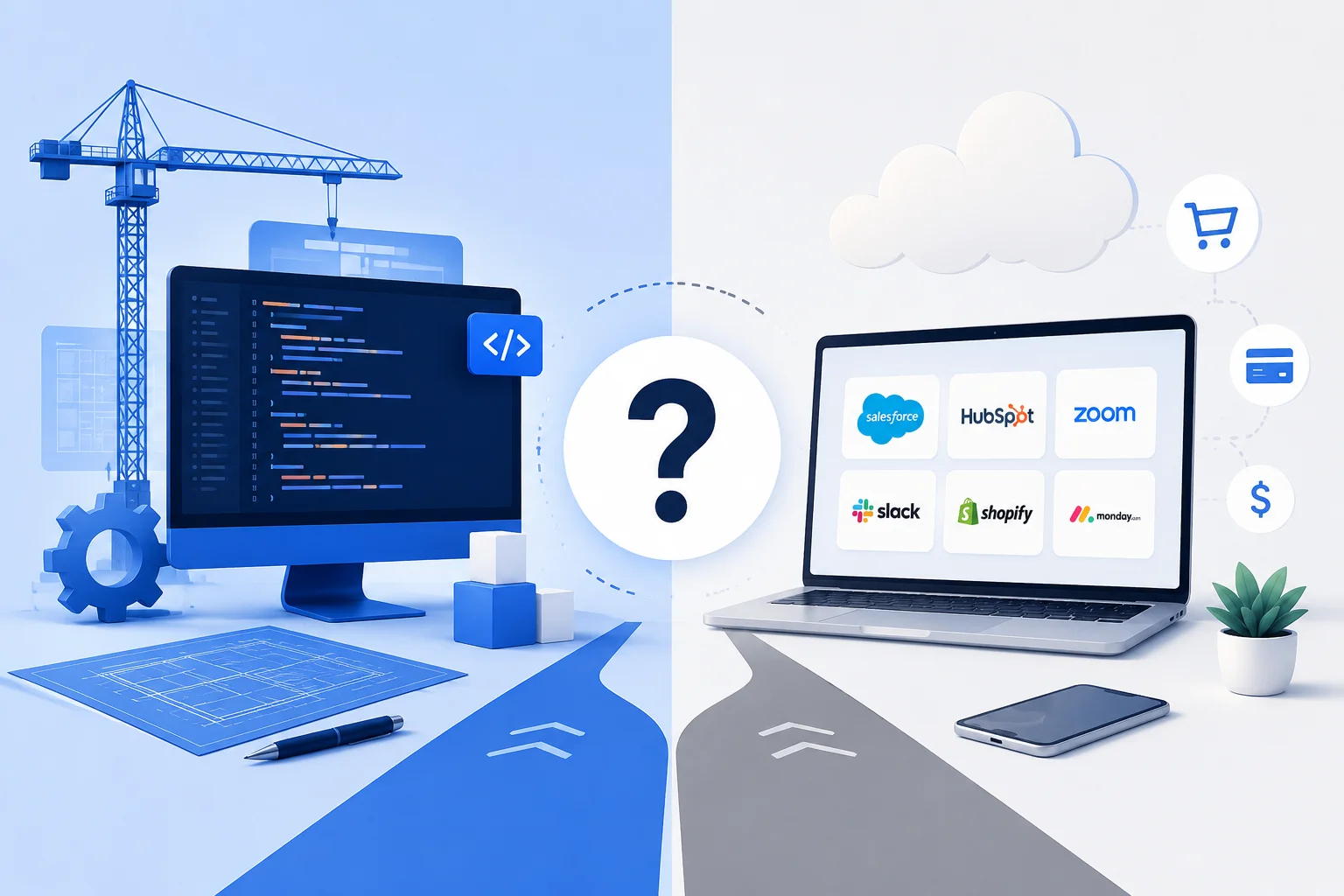
That is usually when the custom software vs SaaS question shows up for the first time. And it is a bigger decision than most people realize, because it affects not just your budget but your operational flexibility, your data ownership, and how fast you can move for years to come.
This guide breaks down the real differences between custom software and SaaS, compares the true costs (not just the sticker prices), and gives you a practical framework for deciding which one your business actually needs.
Quick Answer: Custom Software vs SaaS
Custom software is built from scratch specifically for your business — your workflows, your data model, your rules. SaaS (Software as a Service) is pre-built software sold on a subscription basis that serves thousands of businesses with the same product. SaaS is faster to deploy and cheaper upfront. Custom software costs more initially ($40,000 to $300,000+) but eliminates per-user licensing fees and fits your exact needs. Most businesses should use SaaS for standard functions (email, accounting, project management) and consider custom software for the workflows that make their business different. The break-even point where custom becomes cheaper than SaaS typically falls between 18 months and 3 years.
What Is SaaS?
SaaS stands for Software as a Service. It is software that someone else built, hosts, and maintains — and you pay a monthly or annual subscription to use it.
You already use SaaS products whether you realize it or not. Gmail is SaaS. Slack is SaaS. Shopify, QuickBooks, HubSpot, Salesforce, Zoom, Dropbox — all SaaS. You sign up, log in, and start using it. No development team needed, no servers to manage, no code to maintain.
SaaS companies build one product and sell it to thousands (or millions) of customers. That is how they keep prices low — the development cost gets spread across a massive user base. A feature that costs $500,000 to build only costs $0.50 per customer when 1 million people are paying for it.
Common examples of SaaS products include CRM tools like Salesforce and HubSpot, accounting software like QuickBooks and Xero, project management tools like Asana and Monday.com, email marketing platforms like Mailchimp, e-commerce platforms like Shopify, and communication tools like Slack and Zoom.
What Is Custom Software?
Custom software is software built specifically for one business. It does not exist before you hire someone to create it. It is designed around your workflows, your data, your users, and your business rules — and nobody else’s.
When we built FloCargo at SoftwareOrbits, it was because no SaaS product handled shipment tracking, customer management, weight verification, invoicing, and email marketing the way the client needed. They would have needed 3 or 4 separate SaaS subscriptions stitched together. A custom platform gave them everything in one system built around how they actually operate.
Other real-world examples of custom software include trading platforms built for specific financial markets (like TheFlowShark, which we built for real-time fintech analytics), on-demand staffing marketplaces with custom matching logic (like ShiftTake), inventory management systems for businesses with unique warehouse workflows, patient intake portals for healthcare practices with specific compliance needs, and internal operations tools that automate company-specific processes no off-the-shelf product addresses.
Custom software is not a replacement for every SaaS tool you use. It is a solution for the specific problems where off-the-shelf software falls short.
The Real Differences Between Custom Software and SaaS
The differences go deeper than “build vs buy.” Here is what actually matters.
Ownership. SaaS: you are renting. You pay monthly, and the moment you stop paying, you lose access — including your data in some cases. Custom: you own it. The code, the data, the infrastructure. It is yours forever.
Fit. SaaS: designed for the average business. It handles 80% of what most companies need and forces you to work around the other 20%. Custom: designed for your business. It handles 100% of what you need because it was built to.
Cost structure. SaaS: low upfront, recurring forever, and scaling with every new user you add. Custom: high upfront, low ongoing, and no per-user fees regardless of team size.
Time to launch. SaaS: days to weeks. Sign up and start. Custom: 3 to 6 months for a typical build. Longer for complex platforms.
Integrations. SaaS: integrates well with other popular SaaS tools. Struggles with niche systems, legacy software, or proprietary databases. Custom: integrates with anything that has an API. No restrictions.
Scalability. SaaS: the vendor handles scaling, but your costs increase with every user. Custom: you control the architecture and scaling. No per-seat cost increases.
Updates and maintenance. SaaS: the vendor pushes updates automatically. Sometimes that is great. Sometimes they change a feature you relied on and you have no say in the matter. Custom: you decide when and what gets updated. Your development partner handles maintenance, typically at 15 to 25% of build cost per year.
Data control. SaaS: your data lives on the vendor’s servers, governed by their terms of service. Custom: your data lives on your infrastructure, governed by your policies. This matters significantly for regulated industries.
The Cost Comparison Nobody Shows You Honestly
This is where most custom software vs SaaS comparisons get lazy. They compare the monthly SaaS price to the custom build cost and call it a day. That comparison is incomplete.
The real comparison is total cost of ownership over 3 to 5 years.
SaaS cost example. A team of 50 paying $100 per user per month across two SaaS platforms. That is $10,000 per month, $120,000 per year, $600,000 over 5 years. And that assumes the vendor does not raise prices — which SaaS vendors routinely do.
Custom software cost example. A $120,000 custom build with $20,000 per year in maintenance. Year one: $140,000. Year two: $160,000. Year three: $180,000. Year five: $220,000.
By year three, the custom solution is cheaper. By year five, it has saved $380,000 compared to SaaS — and you own it.
That math does not work for every situation. If your SaaS costs $50 per month total and does everything you need, building custom to replace it is absurd. The break-even analysis only favors custom when your SaaS spending has reached a meaningful scale or when the limitations of SaaS are costing you productivity and revenue in ways that do not show up on the subscription invoice.
The hidden SaaS costs people miss: per-user fees that scale with team growth, feature tier upgrades when you need functionality locked behind higher plans, integration middleware to connect SaaS tools that do not natively talk to each other, the productivity drag of working around limitations the tool was not designed to handle, and data migration costs if you ever want to leave.
The hidden custom software costs people miss: annual maintenance (15 to 25% of build cost), cloud hosting ($2,000 to $10,000+ per year), the discovery phase ($5,000 to $15,000 upfront), and the dependency on your development partner for ongoing support.
Both sides have costs people do not think about. Run the real numbers for your situation before deciding.
When SaaS Is the Right Choice
SaaS is the right answer more often than custom software advocates want to admit. Here is when it wins clearly.
The problem is standard. Email, accounting, payroll, project management, basic CRM, team communication — these are solved problems. Thousands of companies have built great tools for them. Building custom versions of these is almost never worth the investment.
You are early-stage. If you are still figuring out your workflows, locking them into custom software is premature. Use SaaS to learn how your business actually operates, then build custom once you know what you need.
Your team is small. At 5 to 15 users, the per-user SaaS costs are manageable and the speed of deployment matters more than long-term savings.
You need it this week. Custom software takes months. SaaS takes days. If time-to-value is the priority, SaaS wins.
The SaaS tool does 90%+ of what you need. If a tool handles almost everything and the workarounds for the remaining 10% are minor, the cost and time of building custom is hard to justify.
When Custom Software Is Worth It
Custom earns its cost in specific situations. If none of these apply, you probably do not need it.
Your workflow is your competitive advantage. If the way you operate is what differentiates you from competitors, putting that into a generic tool dilutes it. Your competitor using the same SaaS platform has access to the same capabilities. That is not differentiation.
You are spending more time on workarounds than actual work. A useful rule we have heard from multiple clients: if your team spends more than 20% of their time working around what the software cannot do, you have outgrown it.
SaaS licensing costs have become a real budget line. When per-user fees hit $50,000 to $100,000+ per year, the custom build starts paying for itself within 2 to 3 years.
You need integrations that SaaS cannot support. Legacy systems, proprietary databases, industry-specific APIs — SaaS tools restrict you to their supported integration list. Custom connects to anything.
Data ownership and compliance matter. Healthcare (HIPAA), finance (PCI-DSS), government contracts, or any situation where your data needs to live on your infrastructure under your control.
No SaaS product exists for what you need. Sometimes the tool you need simply does not exist. When we built Deuce Data at SoftwareOrbits — a tennis intelligence platform with real-time market analytics, court condition modeling, and player profiling — there was no SaaS product to buy. It had to be built from scratch because the market for it did not exist yet.
The Hybrid Approach: What Smart Businesses Actually Do
Here is something most custom software vs SaaS articles leave out: you do not have to choose one or the other.
The sharpest businesses in 2026 run a hybrid stack. SaaS for the standard functions. Custom software for the workflows that make them different.
A logistics company might use Slack for communication, Google Workspace for email, and QuickBooks for accounting — but build a custom shipment tracking and CRM platform because no SaaS product handles their specific operations. A healthcare clinic might use an off-the-shelf EHR system but build a custom patient intake portal that integrates with it. A staffing agency might use standard payroll software but build a custom marketplace for matching workers to shifts.
The question is not “all custom or all SaaS?” It is “which parts of my operation are standard, and which parts are uniquely mine?” Use SaaS for the standard parts. Build custom for the unique parts.
Is AI Replacing SaaS?
This question keeps showing up in 2026, and it deserves an honest answer.
AI is not replacing SaaS in the sense that SaaS products are disappearing. What is happening is that AI is changing what you can build with custom software — and it is changing the economics of building it.
AI-assisted development has reduced routine coding time by 30 to 50%, which means custom software is faster and cheaper to build than it was even two years ago. At the same time, AI features are being added to SaaS products everywhere — but they are generic AI features designed for the average user, not your specific use case.
For businesses with unique data and unique workflows, the ability to build custom AI features trained on your own data is increasingly compelling. A custom recommendation engine for your specific product catalog. An internal AI assistant that knows your company’s processes. A prediction model built on your historical data.
SaaS is not going away. But the gap between what you can build custom and what SaaS vendors offer is narrowing, and for businesses willing to invest, custom AI-powered software is becoming a real competitive advantage.
Frequently Asked Questions (FAQ)
What is the difference between custom software and SaaS?
Custom software is built specifically for one business, designed around its exact workflows and owned permanently. SaaS is pre-built software sold on a subscription basis to thousands of businesses. SaaS is faster and cheaper to start with. Custom costs more upfront but eliminates per-user fees and fits your exact needs.
What are examples of custom software?
Examples include CRM platforms built for specific industries (like a logistics CRM with shipment tracking), on-demand staffing marketplaces, real-time financial analytics platforms, patient intake portals for healthcare, custom inventory management systems, and internal operations tools that automate company-specific workflows. Any software built for one business’s specific needs is custom software.
What is considered custom software?
Any software application designed and built specifically for a single organization’s requirements rather than sold as a product to many customers. If no other company can buy and use the same software because it was built around your unique processes, it is custom software.
Is custom software more expensive than SaaS?
Upfront, yes. A custom build typically costs $40,000 to $300,000. But SaaS subscription fees compound over time — a $120,000 annual SaaS spend becomes $600,000 over five years. A $120,000 custom build with $20,000 annual maintenance totals $220,000 over the same period. The break-even point usually falls between 18 months and 3 years.
What are examples of SaaS?
Common SaaS products include Salesforce (CRM), HubSpot (marketing and CRM), QuickBooks (accounting), Shopify (e-commerce), Slack (communication), Zoom (video conferencing), Asana (project management), and Mailchimp (email marketing). Any software you access via subscription through a web browser is likely SaaS.
Is ChatGPT a SaaS?
Yes. ChatGPT is a SaaS product — you access it through a browser, pay a subscription for premium features, and OpenAI hosts and maintains the infrastructure. You do not own the software or host it yourself.
Is AI really replacing SaaS?
Not exactly. AI is being added to SaaS products as features, and AI is making custom software faster and cheaper to build. SaaS is not disappearing, but the line between what SaaS offers and what custom software can do is blurring. Businesses with unique needs are increasingly finding that custom AI-powered solutions outperform generic SaaS features.
Can I start with SaaS and switch to custom later?
Yes, and many businesses do. Starting with SaaS helps you learn your workflows before investing in custom. When the SaaS tool’s limitations start costing you real productivity or money, that is the natural time to evaluate a custom build. Data migration from SaaS to custom is a standard part of most custom development projects.
Conclusion
The custom software vs SaaS decision is not about which one is better. It is about which one is better for your specific situation, right now.
SaaS wins when your needs are standard, your team is small, and you need something running quickly. Custom wins when your workflows are genuinely unique, when SaaS costs are compounding, when you need integrations that off-the-shelf tools cannot support, or when data ownership matters.
Most smart businesses in 2026 do not pick one exclusively. They use SaaS for the standard stuff and build custom for the parts of their operation that actually differentiate them. That hybrid approach gets the speed and cost advantages of SaaS where they matter and the precision and ownership of custom where it counts.
If you are trying to figure out where the line is for your business, SoftwareOrbits is happy to talk it through. Our custom software development team builds platforms across logistics, fintech, staffing, healthcare, and more — and we will tell you honestly if SaaS is the better move for your situation. Reach out for a free consultation and we will help you run the numbers.