Developing an app takes three to five months for a standard first version: two to four weeks of planning and design, two to four months of development, and two to three weeks of testing and launch. Simple apps ship in six to ten weeks; complex platforms take six months or more. Scope decisions move timelines more than engineering speed does.
Every founder hears two timelines before starting: the agency promising six weeks and the friend-of-a-friend horror story that took two years. Both are real, and neither is representative. We ship apps for a living, so this guide gives you the timelines we actually quote heading into 2027, what happens inside each phase, the specific things that stretch calendars, and the honest answer to whether AI has changed any of it.
How Long Does App Development Take on Average?
Most professionally built apps launch three to five months after kickoff. The honest spread by tier, from our own pipeline, one firm’s market observation rather than audited industry data:
| Tier | What it is | Typical timeline | Typical cost range |
|---|---|---|---|
| Simple app | One core flow, accounts, standard design | 6–10 weeks | $25K–$60K |
| Standard app | Payments, several integrations, admin panel, custom design | 3–5 months | $60K–$150K |
| Complex app | Marketplaces, real-time features, regulated data, multi-role | 6–9+ months | $150K+ |
Two clarifications make these numbers usable. First, the timeline starts at kickoff, not at idea; the weeks you spend planning, validating, and choosing a partner sit in front of every figure above, and they are the weeks most founders forget to count. Second, timeline and cost travel together but are not the same lever: adding people compresses some phases and not others, which is why a doubled budget does not halve a calendar. The cost side of these same tiers is broken down in our mobile app development cost guide.
If you need a single planning number for a standard business app, use four months from kickoff to the app stores, and treat anything promised under two months as a claim to interrogate rather than a bargain to grab. Padding your own plan to five gives the project room to absorb one surprise without moving a public date, which every first build should assume it will need. The interrogation questions are later in this guide.
What Happens in Each Phase?
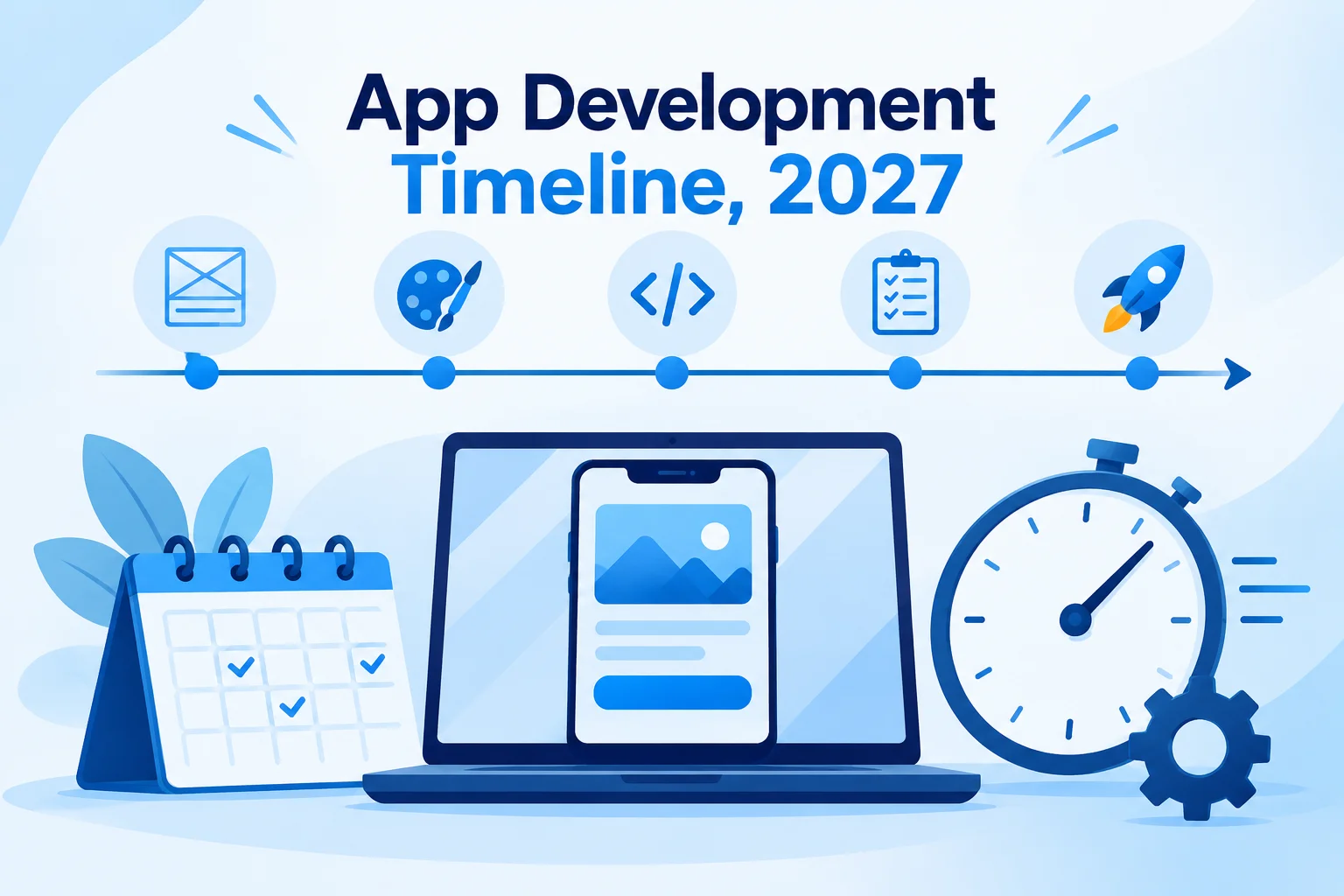
An app timeline is five overlapping phases, and knowing what each one produces tells you whether a project is actually on schedule or just busy:
| Phase | Duration (standard app) | What it produces |
|---|---|---|
| Discovery and planning | 1–2 weeks | Written scope, technical decisions, milestone plan |
| UX/UI design | 2–4 weeks | Flows, wireframes, tested prototype, final screens |
| Development | 8–16 weeks | The product: frontend, backend, integrations |
| Testing and hardening | 2–3 weeks | Real-device QA, security checks, fixes |
| Store submission and launch | 1–2 weeks | Approved listings, monitoring, release |
The phases overlap in a well-run project, which is where good teams quietly win weeks: development starts on validated core screens while design finishes the long tail, and testing runs continuously instead of piling up at the end. A team that runs the phases strictly in sequence is adding a month to any quote you compare, so ask every vendor how they overlap.
Design deserves its reputation as the phase founders squeeze and regret. The two to four weeks of flows, wireframes, and prototype testing is when changes cost conversations instead of sprints, and every week removed there reliably resurfaces as two inside development. The groundwork that comes before all five phases, the decisions, the brief, the validation, is its own discipline, covered in how to plan a software project, and it is the cheapest timeline compression available anywhere in this article.
What Makes App Development Take Longer?
Six factors explain nearly every blown schedule, and the first one explains more than the other five combined:
- Decision latency. Projects wait on client answers more than they wait on code. A question that sits in an inbox for four days pauses the feature behind it, and across a build those pauses compound into the mysterious month nobody can account for. One empowered decision-maker with a reserved weekly hour is worth more to the calendar than an extra engineer.
- Scope growth. Every “while we’re at it” feature adds design, build, and test time, and mid-build additions cost more time than the same feature scoped up front, because they disturb work already done. Phasing is the cure: new ideas go on the version-two list by default.
- Platform count. Two native apps take nearly twice the build of one. A cross-platform build covers both platforms in roughly one build’s time, which is the timeline argument in our native vs cross platform app development comparison.
- Integration surprises. Every external system brings its own documentation quality, sandbox quirks, and approval queues. Payment and banking integrations in particular carry compliance steps with fixed external clocks no team can compress.
- Team and vetting choices. A strong team starts in weeks and ships steadily; a weak one produces the rework that becomes a second, hidden project. The vetting that prevents this adds two weeks up front and saves multiples of that, as laid out in our guide to hiring app developers.
- Regulated domains. Health data, payments beyond a processor, and children’s products add security architecture, documentation, and review steps that move a project up a tier in both time and cost.
Notice the pattern: five of the six are decided before development starts. Timelines are mostly made and broken at the scoping table, not at the keyboard.
What Does a Realistic Timeline Look Like Week by Week?
Abstract phases become a plan when you see one laid on a calendar, so here is the shape of a typical 16-week standard app in our pipeline. Weeks one and two: discovery, written scope, architecture decisions, and the milestone plan everyone signs. Weeks two through five: design, overlapping discovery’s tail, with the prototype in front of test users by week four. Weeks four through thirteen: development, starting on validated core screens while design finishes the rest, with something demonstrable every week and the core flow working end to end around week nine. Weeks twelve through fifteen: testing and hardening, overlapping development’s final stretch, with a release candidate by week fourteen. Weeks fifteen and sixteen: store submission, the soft launch group, and release.
Two things about that calendar are worth noticing. The overlaps are doing real work: run strictly in sequence, the same project takes twenty weeks. And nothing demonstrable arrives later than week four; if you are six weeks into a build and have clicked nothing, the calendar you were sold is already fiction, whatever the status reports say.
How Long Does It Take With Different Team Setups?
The same standard app moves at different speeds depending on who builds it, mostly because of how much work can happen in parallel:
| Team setup | Typical timeline (standard app) | Why |
|---|---|---|
| Solo freelancer | 5–8 months | Every phase queues behind one person |
| Small agency team | 3–5 months | Design, build, and QA overlap |
| Staff augmentation into your team | 3–5 months | Parallel work, but your management sets the pace |
| New in-house team | 6–9 months including hiring | 3–5 months of recruiting before week one |
The in-house row surprises founders most: the build itself matches an agency’s pace, but the calendar starts with a hiring cycle, which is why first products are usually built with external teams even by companies that plan to insource later. The freelancer row is not a criticism; for simple-tier scope one strong developer is efficient, and the queueing penalty only bites when scope demands parallel work.
Has AI Made App Development Faster in 2027?
Yes, by weeks rather than by miracles, and unevenly across the phases. AI coding tools are now universal equipment: Stack Overflow’s 2025 Developer Survey found 84% of developers using or planning to use them, with 51% of professionals using them daily. On our projects they compress development’s repetitive middle, boilerplate, standard screens, test scaffolding, first-draft integrations, which is a real share of the longest phase.
What AI has not compressed is everything that was never typing: deciding what to build, validating it with users, the hard fifth of the backend where your product differs from every other product, and the review of generated code, which arrives fast and subtly wrong often enough that the same survey found more developers distrusting its accuracy (46%) than trusting it (33%). App store review queues and compliance clocks have not read the AI announcements either.
The net effect in our pipeline: standard apps that quoted five to six months three years ago now commonly land at three to five, with the savings concentrated in development and testing. The quotes that should worry you are the ones AI supposedly shrank to three weeks; generation is fast, but the phases that protect quality still take the time they take, and teams promising otherwise are shipping the demo.
How Long Does App Store Review Take?
Shorter than its reputation, with asterisks for first launches. Apple’s App Review page currently states it reviews at least 50% of submissions in under 24 hours and 90% in under 48; Google Play reviews typically clear in a few days. Expedited review exists on Apple’s side for genuine emergencies, though it is a request, not a guarantee.
The asterisks matter for planning. First submissions get more scrutiny than updates, rejections happen to well-built apps over metadata, permissions wording, and guideline interpretations, and each rejection-fix-resubmit loop costs several days. New developer accounts, payment features, and health or finance categories can all draw longer looks. This is why the launch phase in the table budgets one to two weeks rather than 48 hours: the review itself is fast, but the loop around a first launch rarely runs exactly once.
The practical planning rule: submit a release candidate at least two weeks before any date that matters, and never schedule a public announcement on a date an app store controls. Teams that launch often also keep a store-metadata checklist, screenshots, descriptions, privacy labels, permission explanations, precisely because those pages, not the code, cause the most first-launch rejections.
How Can You Ship Faster Without Breaking Things?
Real compression comes from five moves, none of which involve typing faster:
- Cut scope, not phases. The fastest app is the one with fewer screens, not the one that skipped testing. One core flow shipped in ten weeks beats five flows shipped in five months, because the ten-week version starts learning from users twenty weeks earlier.
- Pre-make the decisions. Arrive with the written scope, the success metric, and a named decision-maker. Projects with that package start building in week one instead of week four.
- Choose one platform or cross-platform. Launching a single platform first, or one codebase for both, is the largest single calendar lever after scope.
- Keep the feedback loop daily. Weekly demo meetings create weekly decision cycles; a shared channel where questions die within hours creates daily ones. Same team, same scope, a month’s difference.
- Stage the launch. A soft launch to a small group two weeks before the public date absorbs the surprises that would otherwise land on launch day, and turns store review into a non-event.
One move deliberately missing: adding developers mid-project. Onboarding consumes the existing team’s time before it adds any, so a late team expansion usually slows the exact milestone it was meant to rescue. If the timeline needs saving, scope is the lever that works immediately.
When Is a Fast Timeline a Red Flag, and When Is Slow One?
Both directions of the timeline conversation carry warnings, and vendors are rarely the ones to volunteer them.
A dangerously fast quote has a signature: a confident calendar with no discovery phase, no named testing window, and no questions asked about your integrations or decision process. Six weeks for a standard app is achievable only by deleting the phases whose absence you discover after launch, and the deleted testing phase in particular converts into a public bug tracker with your brand on it. When a quote is dramatically shorter than the others, ask which table rows it removed; “we’re just faster” is not an answer, because the typing was never the long part.
A dangerously slow project has a different signature: months elapsing without anything demonstrable. Healthy projects produce something you can click within the first few weeks and every week or two after; a team that needs a quarter of runway before showing working software is showing you its process, and the process is the problem. Long timelines are legitimate when they are itemized, a regulated integration here, a two-sided marketplace there, and suspicious when they are vague.
The shared test for both: demand the timeline as a milestone list with demonstrable output at each step, then judge the project by milestones met, not by reassurances given. A calendar without checkpoints is a hope with a date on it.
What Happens to the Timeline After Launch?
Launch ends the countdown and starts the clock that actually matters. The first version’s job is to start learning, and the weeks right after release, watching real usage, fixing what reality finds, shipping the first improvements, decide more about the product’s future than any week of the build did. Plan for development to continue at a reduced, steady pace indefinitely: the products that win their categories are the ones still shipping a year later, funded by the 15 to 25 percent annual maintenance line every cost guide warns about.
The post-launch sequence has its own phases, its own first-48-hours checklist, and its own traps, and we gave it a full guide in what happens after you launch an app. For timeline planning, the summary is one sentence: the build takes three to five months, and the product takes as long as it succeeds.
Frequently Asked Questions
How long does it take to develop an app from start to finish?
Three to five months from kickoff to app store for a standard first version: one to two weeks of discovery, two to four weeks of design, two to four months of development, and two to three weeks of testing and launch. Simple apps compress to six to ten weeks; marketplaces, real-time products, and regulated apps run six months or more.
How long does it take to build an MVP app?
Two to four months for a real, engineered MVP with accounts, payments, and one core flow; validation-stage builds using no-code tools take two to four weeks. The MVP timeline responds to scope more than anything else, which is why a one-page feature list with a version-two column is the best schedule tool a founder owns.
Can an app really be built in a month?
A validation build, a no-code product, or a very narrow single-flow tool, yes. A standard custom app with payments and real users’ data, no, not with its testing phase intact. One-month quotes for standard scope are made by deleting discovery and QA, and those phases do not disappear; they move after launch, where they cost users instead of weeks.
How long does app design take?
Two to four weeks for a standard app: user flows, wireframes, a clickable prototype tested with a handful of real users, and final screens. Design overlaps development in a well-run project, so its calendar cost is smaller than its sequence position suggests. Cutting it saves a week on paper and typically costs two in rework.
How long does App Store review take in 2027?
Apple currently states at least 50% of submissions are reviewed within 24 hours and 90% within 48; Google Play typically clears in a few days. First submissions face more scrutiny, and a rejection-and-resubmit loop costs several days per round, so budget one to two weeks for the launch phase and never announce a date the stores control.
Does cross-platform development make the timeline shorter?
Substantially, when you need both iOS and Android: one codebase builds, tests, and ships once instead of twice, covering both platforms in roughly a single build’s calendar. If you only need one platform, the timeline advantage mostly disappears. The trade-offs beyond the calendar are covered in our native vs cross-platform comparison.
Why do app development projects run late?
Mostly for non-engineering reasons: slow client decisions, scope added mid-build, and integration surprises, in that order. The fixes are structural, not heroic: one named decision-maker with daily availability, a default no to mid-build additions, and integrations investigated during discovery rather than discovered during development.
Is it faster to hire one developer or a team?
A team, for anything beyond simple scope, because design, development, and testing overlap instead of queueing behind one person, and nobody’s vacation stops the project. A single strong developer can match a team on narrow builds and costs less, but carries schedule risk concentrated in one calendar. Match the structure to the scope, not to the org chart you imagine later.
Conclusion
Timelines are made at the scoping table, so the week you spend planning buys back the month you would have lost deciding mid-build. Bring us your idea and your real date, and we will give you a milestone-by-milestone timeline honestly, including the tier where the answer is ten weeks and the cases where anyone promising that is deleting the phases you need. Book a free consultation and plan around a calendar with checkpoints instead of a hope with a date.