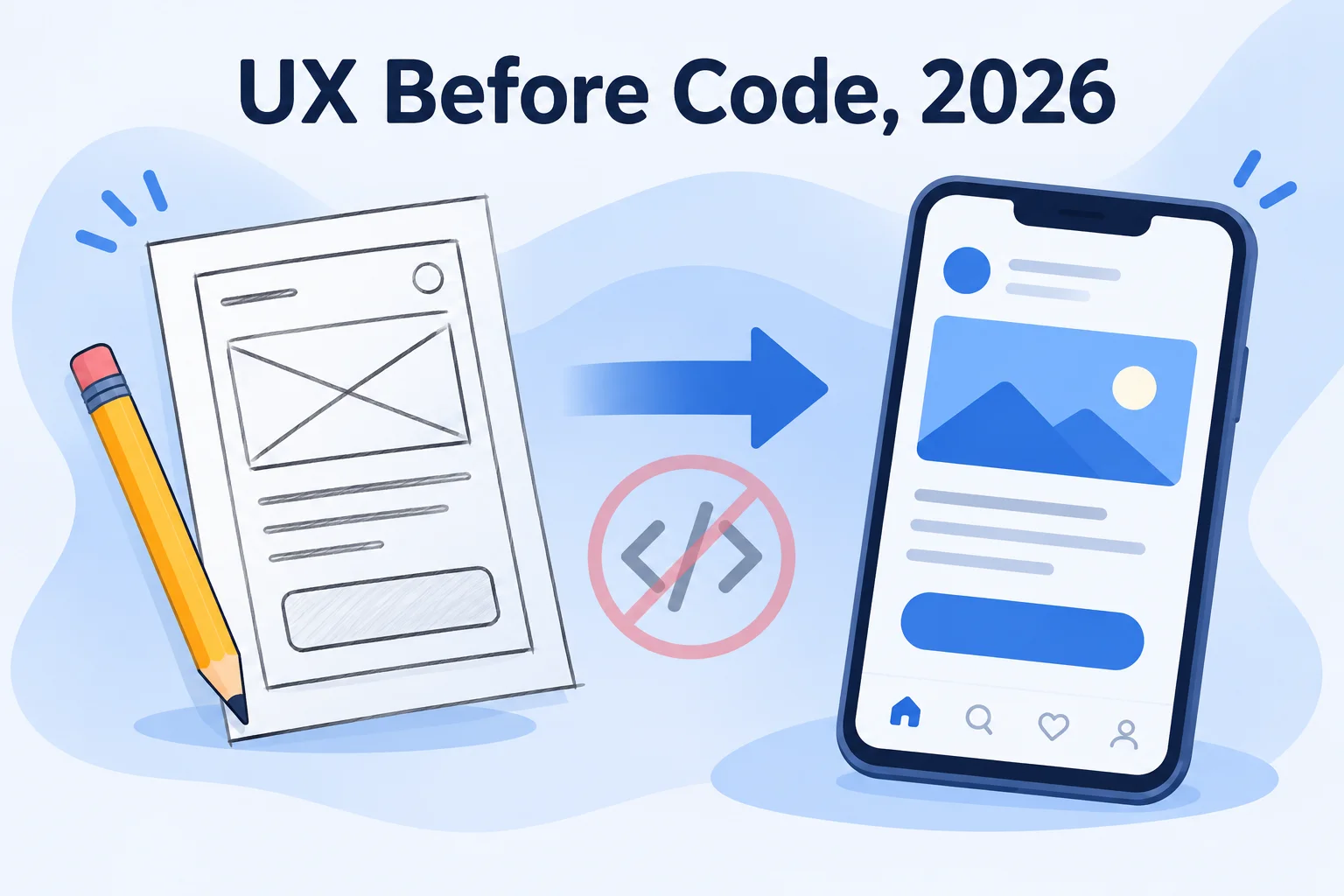
UX design for startups comes before code because changing a sketch costs minutes while changing built software costs weeks. Expect to spend 10 to 20 percent of your development budget on design, roughly $5,000 to $30,000 for a typical first product. Good UX is not decoration; it is the cheapest round of product validation you will run.
Founders tend to meet UX design twice: once as a line item they are tempted to cut, and once more, months later, as the explanation for why users sign up and never come back. We build software for a living, and the predictable difference between projects that track their budgets and projects that drift is rarely the engineering; it is whether anyone drew and tested the product before paying developers to make it permanent. This guide covers what UX design actually is, why its position in the sequence matters more than its polish, what it costs, and the honest cases where skimming on it is fine.
What Is UX Design? (And How Is It Different From UI?)
UX design is deciding how the product works before deciding how it looks: what users are trying to do, what steps get them there, and where they will get confused or quit. UI design is the visual layer on top, the colors, type, and components users actually see. The two get bundled into one job title, but they answer different questions and fail in different ways:
| UX design | UI design | |
|---|---|---|
| Core question | Can users get the job done? | Does it look and feel right doing it? |
| Produces | User flows, wireframes, prototypes | Screens, components, visual style |
| Failure looks like | Confused users, abandoned sign-ups | Dated, generic, or off-brand product |
| Cheapest to fix | On paper, before any code | In the design file, before any code |
| Skill behind it | Research, information architecture | Visual craft, typography, systems |
A product can succeed with ordinary UI on top of strong UX; the reverse is rare. Users forgive plain screens that work and abandon beautiful ones that confuse them, which is why the order of investment for a startup runs UX first, UI second, and animation last. When this article says “design,” it means both layers in that order, delivered through the kind of combined engagement our UI/UX design services run before our own builds.
Why Does UX Design Come Before Code?
Because the cost of changing a decision multiplies at every stage it survives. A flaw caught in a wireframe costs a conversation. The same flaw caught in a clickable prototype costs a revision. Caught after engineers have built it, it costs a sprint, and caught after launch it costs a sprint plus the users who already left. Nothing else in a software project has economics this lopsided, which is why design’s position in the sequence matters more than its budget.
Design-before-code is also validation in disguise, and that is its real job for a startup. A clickable prototype (a linked set of screens that behaves like the app without any code behind it) can be put in front of ten real users in week two, for a fraction of the build cost, and their confusion is the cheapest bad news you will ever receive. The expensive version of that news arrives after launch, and the failure data says most of it is preventable: as we covered in why startups fail at building software, the decisions that kill projects are made, or skipped, long before the code that gets blamed.
The business case is not soft, either. McKinsey’s Business Value of Design study tracked 300 public companies over five years and found top-quartile design performers posted revenue growth 32 percentage points higher, and shareholder returns 56 points higher, than their industry counterparts. Those are established companies, not startups, but the mechanism transfers: the study’s strongest design practices, user research early, design integrated with development, iteration against real feedback, are exactly the practices this article is arguing a startup should buy from day one.
One caution so this section is not mistaken for perfectionism: before code does not mean instead of shipping. The point is sequence, not volume. Two weeks of design before a three-month build multiplies the build’s value; three months of design before anything exists is a stall wearing a process costume, and we flag it as such further down.
What Does UX Design Actually Produce?
A design phase should hand you artifacts you can test, show investors, and hand to any development team, not a folder of inspiration. For a typical startup engagement, in order:
- Research notes and a user definition. A handful of real conversations with target users, distilled into who the product serves and what job it does. Days of work, not weeks, and it anchors every decision after.
- User flows. Diagrams of each path through the product: sign-up, the core action, payment, recovery from errors. This is where entire screens get deleted before they cost anything.
- Wireframes. Grayscale, deliberately ugly layouts of every screen, ugly so that feedback targets structure instead of colors. Most of the arguing should happen here, where arguing is free.
- A clickable prototype. The wireframes linked into something a test user can actually try. This is the validation instrument, and watching five users attempt your core flow with it will change the product more than any meeting.
- UI design. The visual layer applied to validated structure: real screens, a small style system, the product’s face for launch and fundraising.
- A developer handoff package. Specs, assets, and states (loading, empty, error) that let engineers build without guessing. Weak handoff quietly re-adds the cost that design was supposed to remove.
Two omissions are deliberate. A full brand identity is a separate, later purchase; version one needs a clean logo and a consistent system, not a brand book. And a design system worthy of the name comes after product-market fit, built from patterns the product has proven it needs.
How Much Does UX Design Cost for a Startup?
Plan for 10 to 20 percent of the total build budget. In our pipeline, design for a simple MVP runs $5,000 to $15,000 over two to four weeks, a standard product with multiple user types runs $15,000 to $30,000 over four to six weeks, and complex platforms run beyond that. Treat the figures as one firm’s market observation, not audited industry data.
| Tier | What it covers | Typical range | Timeline |
|---|---|---|---|
| MVP design | One core flow, wireframes, prototype, UI for ~10–15 screens | $5K–$15K | 2–4 weeks |
| Standard product | Multiple roles, 20–40 screens, user testing round, handoff package | $15K–$30K | 4–6 weeks |
| Complex platform | Dashboards, data-heavy interfaces, design system foundations | $30K+ | 6+ weeks |
What moves the number is scope you control: screen count, user roles, and how much research and testing you buy. What should not move it much is decoration; a startup paying a premium for bespoke illustration and animation before product-market fit is buying UI jewelry with UX money. The design line also behaves differently from the engineering line in one happy way: it is largely a one-time cost per product generation, while the build cost it protects recurs in maintenance forever, which is part of why the percentages in our MVP development cost breakdown put design at a tenth of the budget and discovery-plus-design failures behind most overruns.
Freelance versus agency pricing follows the same logic as development hiring: a strong freelance designer costs less and fits a single tight scope; a team brings research, UX, and UI as separate competencies and survives one person’s vacation. The vetting is identical too: shipped products you can click, not portfolio screenshots you can admire.
What Does Good UX Actually Do to Revenue?
It moves the two numbers startups die by: conversion and retention. The clearest public evidence comes from e-commerce, where the money is easiest to count. The Baymard Institute’s research puts average cart abandonment at 70.22% across 50 studies, finds 17% of shoppers have abandoned purchases because the checkout was too long or complicated, and estimates the average large e-commerce site can lift conversion 35.26% through better checkout design alone. Nothing in that sentence required a new product, a new market, or a new feature; it is the same product with fewer places to get stuck.
The retention version of the same effect is harder to publish and easier to feel: products that make the first session effortless get a second session. We watched this play out at consumer scale with QUITTR, where the product’s entire premise, being reached for daily, at hard moments, lives or dies on friction. The design work there was not decoration on top of the app; it effectively was the app, and more than 2 million users later, that allocation of effort looks like the correct one.
The startup translation: every point of friction in your core flow is a tax on every user forever, and design is the discipline of finding those taxes while they are still drawings. Paying an engineer to rebuild a confusing flow is the same work at ten times the price.
A concrete example of the mechanism, from a recent booking product we designed. The founder’s spec had a five-step sign-up before anyone could see availability, because every competitor did it that way. The prototype test made the problem undeniable: four of five test users quit at step three. The redesign let people browse first and sign up at the moment of booking, when motivation is highest. That change cost two days of design time and deleted two screens from the build. Found after launch, the same insight would have cost a rebuilt onboarding flow, a migration for existing accounts, and every user who had already bounced off the old one.
There is a fundraising dividend too, worth naming because it often pays for the design phase by itself. A clickable prototype is the best pitch asset a pre-launch startup can own: investors experience the product instead of imagining it from slides, and user-test results turn “we believe” sentences into “we observed” sentences. Several of our clients have raised on the prototype months before the build finished, which reframes the design line from cost to runway.
When Can a Startup Skim on UX Design?
Sometimes, and a design-selling firm should say so plainly. Skim when the product is an internal tool for a captive audience of five; a template-grade interface on solid workflows is the right spend, and your users’ training replaces onboarding design. Skim when you are at the validation stage, where a landing page and a concierge test answer the demand question before any screens deserve investment. Skim when you are building strictly B2B plumbing whose buyers evaluate the API and the contract, not the dashboard. And skim on the UI layer specifically whenever budget forces a choice, because clean-and-plain on validated UX beats gorgeous-and-confusing every time.
Do not skim when the product is consumer-facing and habit-based, where friction is fatal. Do not skim on marketplaces and multi-role products, where two audiences must both succeed or neither does. And do not mistake skipping design for saving money when the plan is to “fix the UX later”; later means rebuilding at engineering rates, and the rebuild inherits users’ first impressions too.
The other honest failure mode is the opposite one: design as procrastination. If the prototype has been iterating for two months without meeting a user, or the team is debating button colors before the core flow has been tested once, design has stopped de-risking the build and started delaying it. The test is the same as for planning: design until a stranger can use the prototype and a developer can price it, then stop and build. Budget-wise, the compressed floor for any external-facing product is about a week: flows, wireframes for the core path, and five user tests. Below that floor you are not saving design money; you are moving it into the engineering column at a worse exchange rate.
How Does Design Fit Into the Development Process?
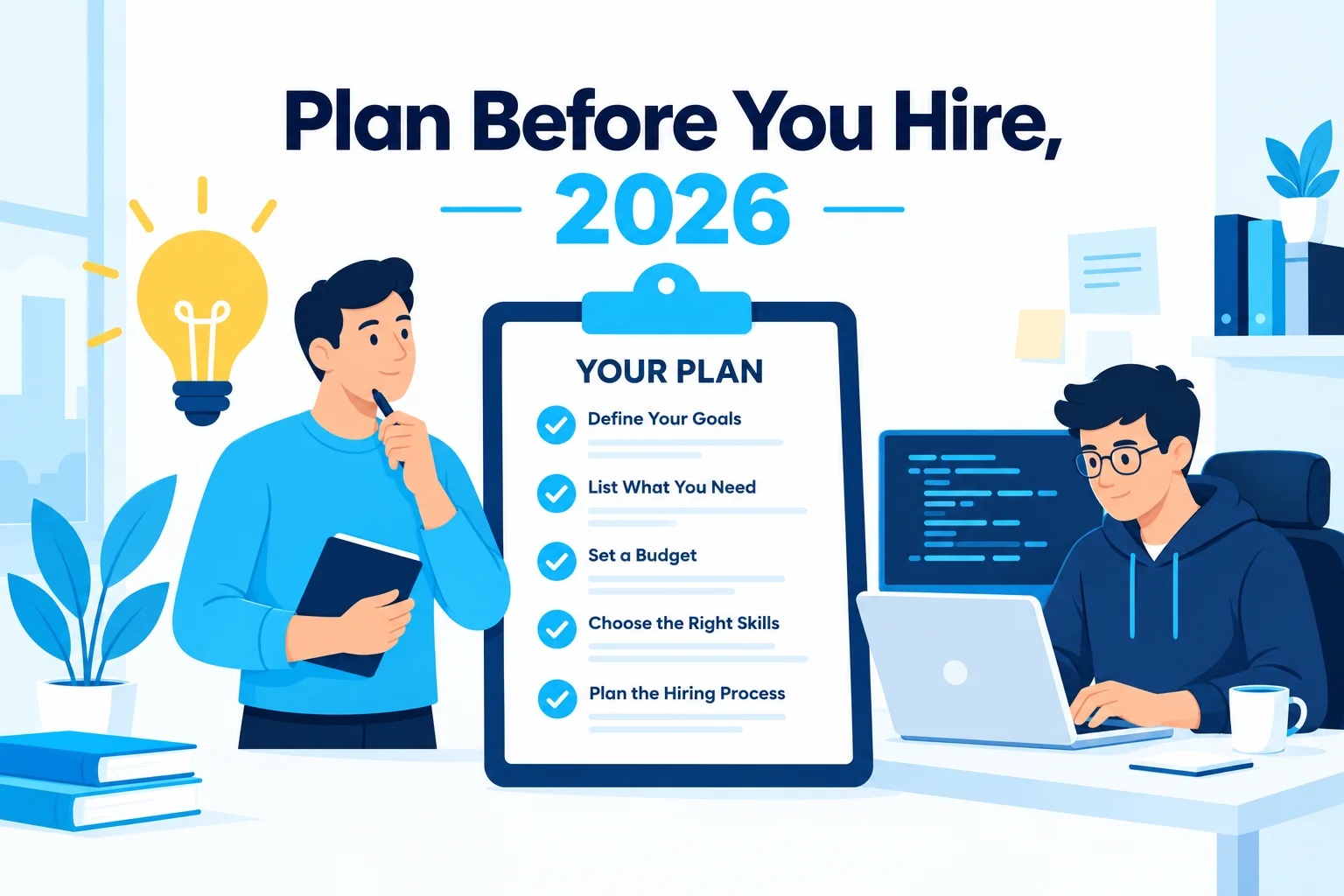
Design works best as the bridge between your plan and the build, overlapping both rather than sealed off from either. The sequence that works: the founder’s one-page plan feeds a short discovery, design produces and tests the prototype, engineering starts on validated screens while design finishes the long tail, and the designer stays available through the build for the hundred small decisions that surface. The groundwork that makes this smooth, the decisions, the brief, the validation, is exactly what we laid out in how to plan a software project, and design is where that plan first collides with something users can touch.
What should you actually do with this as the founder? Stay in the room. The highest-value hours you will spend on the whole project are the ones watching strangers use the prototype, because secondhand summaries of user confusion never carry the force of seeing someone stuck on your favorite screen. Founders who attend the tests make scope cuts cheerfully; founders who read the report negotiate with it.
Two structural choices save startups real money here. First, design and development under one roof, or at least in one conversation, because the costliest design is the kind engineering quietly discovers is unbuildable in week six; integrated teams price feasibility into the screens as they are drawn. Second, a thin, continuous design presence through the build beats a big upfront package that goes stale, because products change on contact with reality and someone has to change the screens coherently.
And one modern note: AI tools now generate screens in seconds, which tempts founders to believe design is becoming free. What those tools generate is UI, the visual layer, and often respectable UI. What they do not do is interview your users, find the step everyone abandons, or decide which three screens should not exist. The thinking layer is the one this article has been pricing, and for now it is also the layer that decides whether the pretty screens are the right ones.
Frequently Asked Questions
What is UX design in simple terms?
UX design is working out how a product should work before building it: what users are trying to accomplish, the steps that get them there, and where they will get confused or give up. It produces flows, wireframes, and a clickable prototype you can test with real users. UI design, the visual styling, sits on top of it.
How much does UX design cost for a startup?
Plan 10 to 20 percent of your development budget: in our pipeline, $5,000 to $15,000 for a simple MVP’s design, $15,000 to $30,000 for a standard product with multiple user types, and more for complex platforms. Screen count, user roles, and testing depth move the price; decoration should not, at startup stage.
How long does UX design take?
Two to four weeks for an MVP and four to six for a standard product, including a round of user testing on the prototype. Design can overlap the start of development once core screens are validated, so the calendar cost is smaller than the sequence suggests. Months of design without user contact is a warning sign, not thoroughness.
What is the difference between UX and UI design?
UX decides how the product works: flows, structure, and whether users can complete their task. UI decides how it looks: color, typography, and components. A plain interface on sound UX succeeds far more often than a beautiful interface on confused UX, which is why startups should buy them in that order, usually from the same engagement.
Can I skip UX design for my MVP?
You can compress it, not skip it. Even a one-week pass, flows, wireframes, and five user tests on a prototype, catches the failures that are expensive in code. Full skipping makes sense only for internal tools with captive users or pre-product validation experiments. “We’ll fix the UX later” means rebuilding at engineering rates with users who already formed first impressions.
What deliverables should I expect from a UX designer?
Research notes and a user definition, user flows, wireframes, a clickable prototype, finished UI screens with a small style system, and a developer handoff package covering specs, assets, and states like loading and errors. If a proposal lists only “designs,” ask which of these it includes; the handoff package is the one most often quietly missing.
Do developers do UX design?
Some do, most don’t, and the roles think differently even when one person holds both. Developers optimize for building correctly; designers optimize for whether the thing should be built that way at all. Small teams can share the duties, but someone must own the user’s side of every decision, and on most projects that is a distinct skill worth its line item.
Should a startup hire a freelance designer or an agency?
Freelancers fit tight, single-product scopes when you can judge the work; agencies and integrated design-development teams fit multi-role products and anyone who wants feasibility priced into the screens as they are drawn. Vet both the same way: products you can actually click, references that answer what went wrong, and a paid trial scope before the full engagement.
Conclusion
The cheapest version of your product to fix is the one that exists only as drawings, and the startups that use that window buy their builds with evidence instead of hope. Bring us your idea or your plan, and we will tell you honestly how much design it needs, including the tiers where a week is enough and the cases where you should validate before paying anyone to draw. Book a free consultation and put a prototype in front of users before a single sprint gets invoiced.