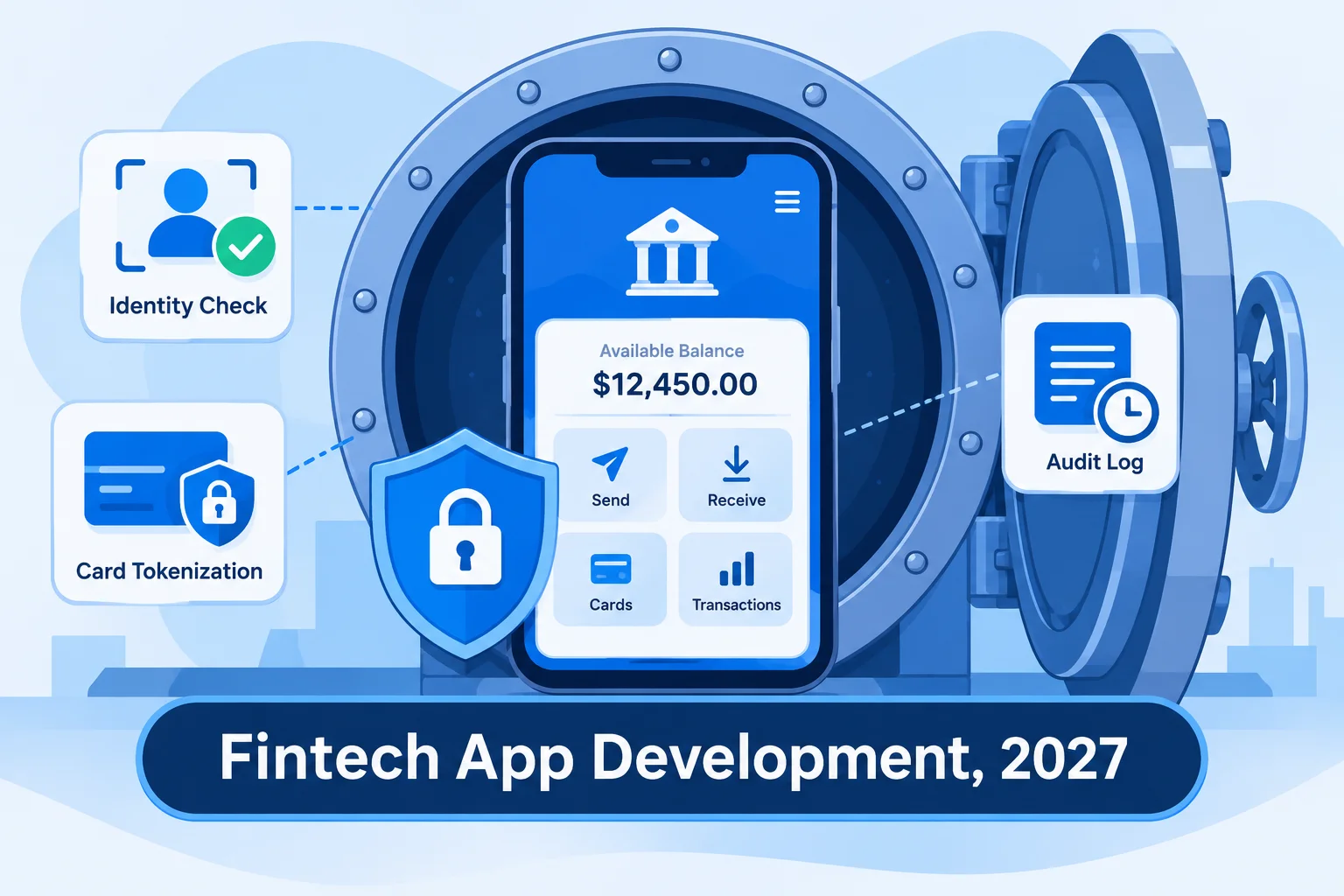
Fintech app development means building on regulated rails: payments through PCI-compliant processors, identity through KYC providers, and money movement through partner institutions. Most startups rent that compliance rather than carrying it alone. Expect $80,000 to $300,000 or more for a serious first version, with compliance architecture responsible for much of the premium over ordinary apps.
Fintech keeps earning its place on founder shortlists, because the prize is category-defining: products that sit inside people’s financial lives retain like nothing else. It is also the category where founders most overestimate one barrier and underestimate another. The overestimated one is regulation itself, because the modern fintech stack lets a startup rent most of its compliance from licensed providers. The underestimated one is engineering discipline, because money is the one domain where a rounding bug is a customer-support fire and an audit question at the same time. We build in this space, including TheFlowShark, a real-time trading platform, so this guide covers what actually applies to your app, what it costs, and the build order that keeps regulators and users equally calm. One caveat before anything else: we are engineers, not lawyers, and a fintech attorney should confirm your specific obligations before launch; this guide gives you the working knowledge to make that conversation short and cheap.
What Counts as a Fintech App, and Which Rules Follow It?
“Fintech” spans five very different builds, and the rules follow the function, not the label. A personal finance app that displays accounts and budgets touches the lightest obligations. A payments app moves money and inherits card-network and processor rules. A lending app triggers credit regulations and disclosure requirements. An investing or trading app answers to securities rules through its brokerage partner. A neobank, banking services under your brand, carries the heaviest load, managed through a partner bank whose regulators now care about you.
The structural insight that shapes every modern fintech budget: you almost never face these rules naked. The ecosystem has specialized providers whose entire business is carrying regulated functions for you, payment processors that keep card data off your servers entirely, identity providers that run KYC checks (know your customer, the legally required identity verification), account aggregators that fetch bank data with user consent, and banking-as-a-service platforms that put a licensed institution under your product. Building fintech in 2027 is mostly the art of composing those rails well, which is why integration quality, the subject of our API integration guide, is the real engineering center of the category.
What the rails do not remove: responsibility for your own application’s security, your users’ data, honest interfaces, and the audit trail proving all of it. Renting the regulated functions shrinks the compliance surface; it never shrinks it to zero.
Which Regulations Do Fintech Founders Actually Meet?
Six frameworks cover most of what a US-focused fintech startup encounters, and knowing which ones your app type triggers is the scoping conversation:
| Framework | What it governs | When it reaches you |
|---|---|---|
| PCI DSS | Payment card data security | Any card payments; minimized by tokenizing through a processor |
| KYC / AML (BSA) | Identity verification, anti-money-laundering | Accounts that hold or move money; usually run via identity providers |
| GLBA | Safeguarding consumer financial data | Broadly, once you handle consumer financial information |
| State money transmitter licenses | Holding or transmitting funds yourself | Avoided by most startups via processors and partner banks |
| SOC 2 | Security practices audit | Demanded by banks and enterprise partners, not law |
| GDPR and state privacy laws | Personal data rights | EU users or covered states, regardless of fintech status |
PCI DSS deserves the concrete version because every founder meets it first. The PCI Security Standards Council defines it as “a baseline of technical and operational requirements designed to protect payment account data,” applying to entities that store, process, or transmit cardholder data. The practical translation: never store, process, or transmit raw card data. Tokenized integration with a major processor keeps your systems outside the heaviest scope, reducing your obligation to a manageable questionnaire instead of a six-figure audit, and any architecture that puts raw card numbers on your servers should be treated as a design error until proven otherwise.
The quiet one on the list is SOC 2, which is not a law at all: it is the security audit your partner bank, BaaS platform, and enterprise customers will demand contractually. In practice it functions as fintech’s entry ticket, and budgeting for it in year one beats discovering it as a deal-blocker in month nine.
What Does Fintech Compliance Require Technically?
The frameworks converge on an engineering checklist, which is good news: build it once, satisfy many masters. What we implement on fintech projects:
- Tokenization at every money boundary. Card data, bank credentials, and account numbers live with the specialized providers; your systems hold tokens. This single pattern removes whole categories of scope.
- Encryption in transit and at rest, including backups, exactly as in any regulated build.
- Strong authentication and session discipline. Multi-factor authentication as baseline, step-up checks for sensitive actions, aggressive session controls.
- Immutable audit trails. Who did what, to which account, when, and from where, captured for every money-touching action. In fintech the audit trail is not compliance decoration; it is how disputes, fraud cases, and regulator questions get answered.
- Ledger-grade correctness. Double-entry records, idempotent transactions (safe to retry without double-charging), and reconciliation against the processor’s records. This is the row that separates fintech engineering from app engineering.
- Fraud and anomaly monitoring. Velocity checks, device signals, and the reporting hooks AML obligations expect, mostly via providers, wired in rather than bolted on.
- Data retention and deletion policy, implemented, not just written, because financial records carry retention minimums that collide with privacy deletion rights and the collision must be designed.
None of this is exotic; all of it is unforgiving. The difference from ordinary apps is less the list than the tolerance: a social app’s edge-case bug annoys someone, and a fintech app’s edge-case bug moves money wrongly, which is why testing and reconciliation carry bigger budget shares here than anywhere else we build.
How Much Does a Fintech App Cost to Build?
Fintech apps run $80,000 to $300,000 and beyond, the same band our mobile app development cost guide publishes for the category, and the spread maps cleanly to how close your app sits to the money. From our pipeline, one firm’s market observation:
| Tier | What it is | Typical range | Timeline |
|---|---|---|---|
| Display and insight | PFM, budgeting, dashboards reading data via aggregators | $80K–$140K | 3–5 months |
| Transactional | Payments, transfers, wallets moving money through processors | $140K–$250K | 4–7 months |
| Regulated platform | Trading, lending, banking features via brokerage or bank partners | $250K–$500K+ | 6–12 months |
Lighter web-based validation builds can start below the band, but the band is honest for products real users trust with real money. The premium over ordinary apps buys specific rows: the provider integrations (each with its own sandbox, review, and go-live process on external clocks), the ledger and reconciliation engineering, the audit and monitoring infrastructure, expanded testing, and the documentation that partners and auditors will ask to see. Provider fees also join your running costs: processors, KYC checks, and aggregator calls all meter per use, which belongs in your unit economics from day one, alongside the ordinary 15 to 25 percent annual maintenance line.
One more line founders miss until it surfaces in a term sheet: the SOC 2 audit itself, typically five figures including preparation, plus the internal time to operate the controls it certifies. It is optional right up until a bank partner or enterprise customer makes it mandatory, which is why we flag it in year-one budgets rather than letting it ambush year two.
The budget mistake specific to fintech: pricing the app and forgetting the partnership calendar. Bank and brokerage partners run diligence on you, BaaS onboarding takes weeks to months, and those clocks run on relationship time, not sprint time. The fix is sequencing, starting partner conversations during design rather than after the build.
What Does a Fintech App Cost to Run Every Month?
Fintech is the category where runtime costs deserve their own line in the unit economics, because the rails meter per use. Expect three stacks. Provider fees: processors take their percentage and per-transaction fees, KYC checks bill per verification, and aggregator calls bill per connected account or refresh, which together mean every new user and every transaction carries a marginal cost that most app categories simply do not have. Infrastructure: high-availability expectations push fintech hosting above ordinary app baselines, commonly several hundred to a few thousand dollars monthly as volume grows. And maintenance: the standard 15 to 25 percent of build cost annually, with fintech’s audits, partner reviews, and provider API migrations keeping the line honest.
The design consequence is worth stating plainly: model these costs at three volume scenarios before building, exactly as you would an AI product’s usage bill, because a pricing model that ignores per-user provider fees can be structurally unprofitable at scale while looking fine in a demo. We price this modeling into discovery on fintech projects because retrofitting unit economics is far more painful than designing them.
To make the build side concrete, here is how a typical $180,000 transactional wallet distributes in our pipeline: discovery, the money-flow map, and partner selection (~$15K), ledger and audit architecture (~$25K), provider integrations across processor, KYC, and aggregator (~$45K), the product build on top (~$55K), fintech-grade testing including reconciliation and idempotency runs (~$25K), and launch with monitoring and capped rollout (~$15K). The rows that ordinary apps lack, ledger, provider plumbing, expanded testing, are the premium, and every one of them is cheaper than its absence.
What Happens If You Get It Wrong?
Fintech failure modes come in three escalating flavors, and all three are cheaper to prevent than to survive. User-trust failures, a wrong balance, a double charge, a frozen withdrawal, kill fintech products faster than any other category, because the product is trust wearing an interface. Security failures carry the industry’s price tag: the IBM Cost of a Data Breach report puts the global average at $4.99 million in its 2026 edition, a record high, with financial services perennially among the most expensive industries in its rankings, and a startup’s version of that event is usually terminal. And compliance failures escalate from partner offboarding, your processor or bank simply dropping you, through state and federal enforcement, with the offboarding version arriving far more often and with no hearing.
The pattern across all three: the cause is almost never the regulation nobody read; it is the engineering shortcut nobody re-examined. The prevention is correspondingly unglamorous, and it is mostly the checklist above plus one habit: a monthly reconciliation review where someone compares your ledger, your processor’s records, and your bank partner’s statements and explains every discrepancy, however small. Teams that keep that habit catch their problems as line items; teams that skip it meet their problems as incidents. Raw card data “temporarily” stored, an audit log added “later,” reconciliation done by spreadsheet. Fintech punishes deferred rigor, which is the honest argument for buying the discipline up front.
When Is Full Compliance Not Your Problem (Yet)?
More often than the compliance-industrial complex suggests, and knowing the boundary saves six figures. If your app only reads financial data through an aggregator with user consent, you are a data handler with GLBA-grade security duties, not a money transmitter. If payments run entirely through a tokenized processor checkout, PCI scope collapses to the light questionnaire. If money movement and accounts live with a partner bank or BaaS platform, the licenses are theirs, and your obligations are contractual: their diligence, their rules, their audits of you. The de-scoping logic is identical in spirit to the one we mapped for health apps in our healthcare app development guide: the first compliance question is never “how do we comply” but “which obligations are actually ours.”
The honest counterweights. Renting rails means renting dependence: your processor’s risk team can end your business in an email, so provider choice and a credible second option are strategy, not procurement. Contractual compliance is still compliance, with real audits and real teeth, just friendlier paperwork. Growth moves the boundary, because the economics that make BaaS cheap at ten thousand users can invert at a million, which is when fintechs start insourcing licenses deliberately. And none of this outruns the baseline: your own app’s security, honesty, and auditability stay yours at every stage. Where exactly your product sits on this map is the one question worth an attorney’s hour before any code is written.
How Do You Build a Fintech App Step by Step?
The sequence matters more in fintech than anywhere else, because partners and regulators sit inside the critical path:
- Map the money flow and the obligation owner for each step. One page: where funds and data move, which provider or partner carries each regulated function, what remains yours. Confirm it with a fintech attorney in writing.
- Choose the rails before the features. Processor, KYC provider, aggregator, and bank or brokerage partner as applicable, selected on compliance fit, economics at scale, and offboarding risk, not just API aesthetics.
- Start partner diligence immediately. Their clocks are the longest in the project; run them parallel to design, not after it.
- Design the ledger and audit trail first. Money correctness is architecture, not a feature; retrofitting double-entry discipline into a shipped app is the most expensive rework in the category.
- Build with the checklist as acceptance criteria, tokenization through monitoring, each shipping with its feature rather than as a hardening phase.
- Test like an auditor and a fraudster. Reconciliation runs, idempotency under retries and failures, permission boundaries, and the unhappy paths where networks drop mid-transaction.
- Soft-launch with limits. Capped amounts, monitored closely, expanding with evidence, which is also exactly what your partners will want to see you doing, and the cheapest possible rehearsal for the scale that follows.
Frequently Asked Questions
How much does fintech app development cost?
Expect $80,000 to $140,000 for data-display products like PFM and dashboards, $140,000 to $250,000 for transactional apps moving money through processors, and $250,000 and up for trading, lending, or banking platforms built on partners. The premium over ordinary apps pays for provider integrations, ledger-grade correctness, audit infrastructure, and expanded testing, plus per-use provider fees at runtime.
How long does it take to build a fintech app?
Three to five months for display-tier products, four to seven for transactional apps, and six to twelve for regulated platforms, with one fintech-specific addition: partner and provider onboarding runs on its own calendar, from weeks to months, and belongs in the plan from day one. Starting those conversations during design keeps them off the critical path.
Do I need a license to build a fintech app?
Usually not at the start, and this is the category’s best-kept open secret: processors, KYC providers, and partner banks carry the licenses for most startup architectures. You inherit contractual obligations to those partners instead. Licenses become your problem when you hold or transmit funds yourself, which is a deliberate scaling decision, not a day-one requirement. Confirm your specific case with a fintech attorney.
What is PCI DSS compliance for an app?
PCI DSS is the card networks’ security standard for anyone who stores, processes, or transmits cardholder data. For most apps the right answer is architectural: tokenize payments through a major processor so raw card data never touches your systems, which collapses your scope to a light self-assessment. Storing card numbers yourself moves you into heavy audit territory and is almost never worth it.
What is the difference between KYC and AML?
KYC is the identity-verification step, confirming who your customer is at onboarding, while AML is the broader anti-money-laundering program: monitoring transactions, flagging suspicious activity, and reporting obligations under the Bank Secrecy Act. Startups typically run KYC through specialized providers and inherit AML monitoring frameworks from their processor or partner bank, wiring the hooks rather than building the program.
Can a fintech app use AI features?
Yes, with the domain’s usual discipline sharpened: AI that categorizes spending or drafts insights is routine, while AI touching credit decisions inherits fair-lending scrutiny, and anything user-facing needs guardrails against confidently wrong financial statements. The budget math follows our AI cost guide, plus fintech’s audit-trail expectations applied to model-driven actions.
What stack do fintech apps use?
The differentiating choices are not languages but rails: which processor, KYC provider, aggregator, and partner institution, plus ledger discipline in the data model. Mainstream application stacks serve fintech fine, and the vetting question for any team is not “which framework” but whether they can explain tokenization, idempotency, and reconciliation without notes.
What is the biggest mistake first-time fintech founders make?
Treating compliance as a launch-blocking mystery instead of an architecture decision, in either direction: some burn months over-engineering for licenses they do not need, others defer the audit trail and ledger discipline that cannot be retrofitted cheaply. The fix is the same one-page money-flow map, an attorney’s confirmation, and rails chosen before features.
Conclusion
Fintech rewards the founders who treat compliance as architecture and punishes everyone who treats it as paperwork, and the difference is set in the first month, not the last. Bring us your money-flow sketch and we will map the rails, the real obligations, and the honest budget tier, including the cases where the answer is a lighter build on rented compliance while you prove demand. Book a free consultation and start your fintech build with the map instead of the maze.