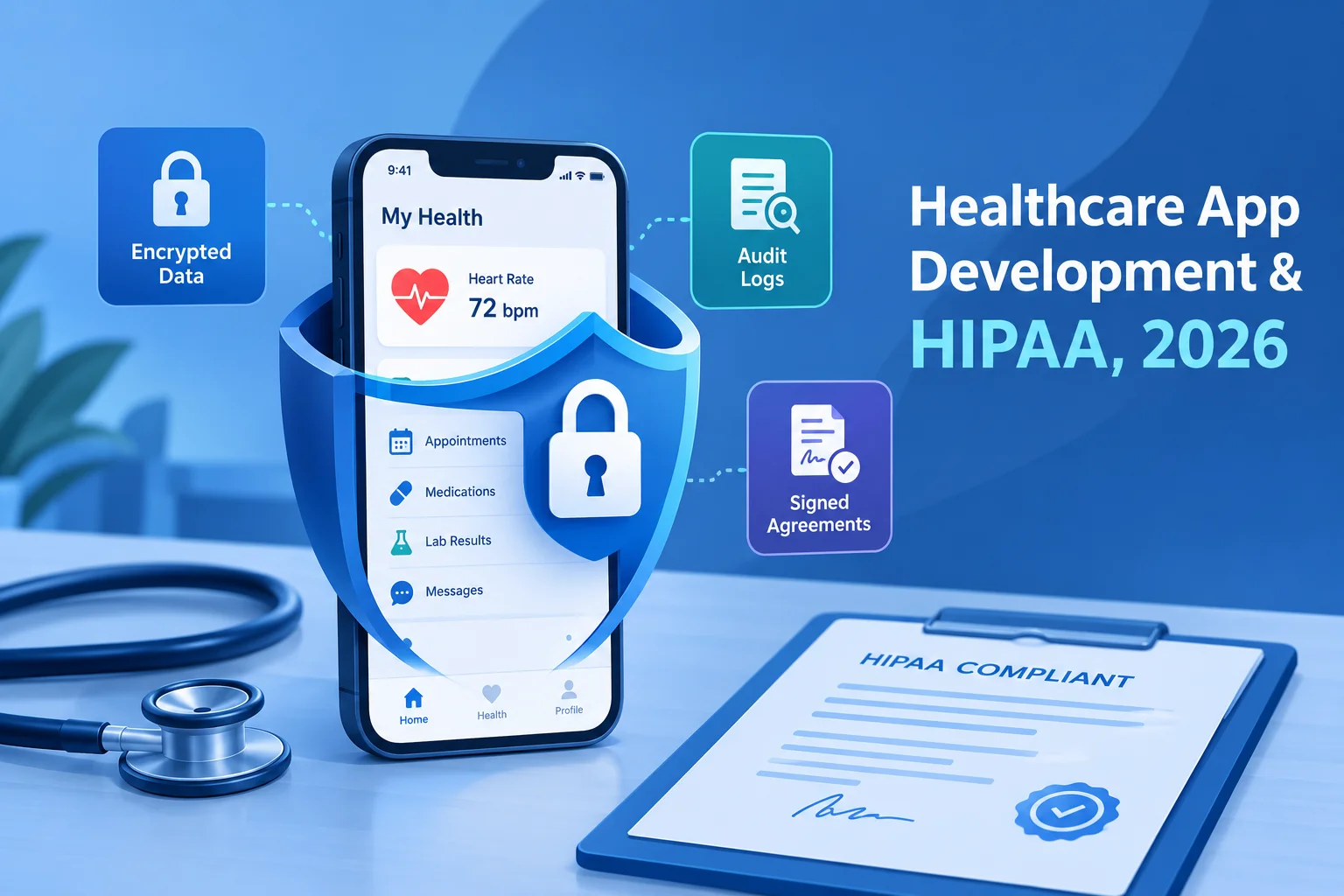
Healthcare app development falls under HIPAA whenever your app creates, stores, or transmits protected health information on behalf of a provider, insurer, or their partners. Compliance means encryption, access controls, audit logging, and signed agreements with every vendor that touches the data. In our projects, it adds roughly 20 to 40 percent to cost and timeline.
Health apps are one of the most attractive categories a founder can build in, and the one where a scoping mistake carries federal consequences. The good news is that HIPAA is more navigable than its reputation suggests once you understand what it actually regulates, which is narrower than most founders assume, and what it demands, which is more specific than most agencies explain. One caveat before anything else: we are engineers who build compliant systems, not lawyers, and a healthcare attorney should review your specific situation before launch. This guide gives you the working knowledge to have that conversation cheaply.
Does HIPAA Apply to Your App?
HIPAA applies to your app if it handles protected health information for a covered entity or one of its business associates; it does not automatically apply just because your app touches health data. That distinction surprises founders in both directions, and it is the single most valuable thing to understand before scoping anything.
The chain works like this. Covered entities are healthcare providers, health plans, and healthcare clearinghouses. Business associates are companies that handle PHI (protected health information, any health data tied to an identifiable person) on a covered entity’s behalf. If your app serves doctors, clinics, hospitals, insurers, or any company in their data chain, you are almost certainly a business associate, and HIPAA applies with full force.
Now the other direction. A wellness app sold directly to consumers, with no provider or insurer in the loop, generally sits outside HIPAA entirely. QUITTR, the wellness app we built that now serves over 2 million users, is exactly this shape: users track their own progress for themselves, no covered entity ever touches the data, and HIPAA does not govern it. That does not mean unregulated; the FTC’s health privacy rules, its Health Breach Notification Rule, and state privacy laws still apply to consumer health apps, and taking privacy seriously is good business regardless. But the compliance architecture, cost, and timeline are entirely different.
The scoping question, then, comes before every technical question: who is the customer, and does a covered entity sit anywhere in the data flow? A meditation app for consumers is one project. The same app sold to hospitals as an adjunct to treatment, with data flowing to clinicians, is a different and more expensive project. Some of the smartest healthcare founders we work with deliberately sequence this: launch direct-to-consumer first, prove the product, and add the HIPAA-regulated B2B channel as a funded second phase.
What Are the Three HIPAA Rules Founders Need to Know?
Three rules do most of the work in HIPAA, and each answers a different question:
| Rule | Question it answers | What it means for your app |
|---|---|---|
| Privacy Rule | Who may see and use PHI, and for what purposes | Consent flows, minimum-necessary access, patient rights to their data |
| Security Rule | How electronic PHI must be protected | The technical and organizational safeguards your architecture must implement |
| Breach Notification Rule | What happens when protection fails | Detection capability, and notification of affected individuals and HHS on strict timelines |
For a development project, the HIPAA Security Rule is where most of the engineering lives. HHS frames it as three safeguard categories: administrative safeguards (policies, training, risk analysis, and a named security officer), physical safeguards (protecting the facilities and hardware where data lives, largely inherited from your cloud provider), and technical safeguards (the encryption, access control, and audit capabilities built into the software itself).
The Breach Notification Rule deserves more founder attention than it gets, because it quietly imposes an engineering requirement: you cannot notify anyone about a breach you cannot detect. Logging and monitoring are not compliance decoration; they are the mechanism that makes the legally mandated timeline achievable at all.
What Does HIPAA Require Technically?
The Security Rule’s technical safeguards translate into a concrete engineering checklist. This is what we implement on HIPAA projects, and what any vendor you evaluate should be able to walk you through without hesitation:
- Encryption in transit and at rest. All PHI encrypted on the wire (TLS) and in storage, including databases, file stores, and backups. Technically “addressable” rather than mandatory in the rule’s language, but treating encryption as optional is how companies end up in breach headlines.
- Unique user identification and authentication. Every user individually identified, with strong authentication; shared logins are a compliance failure by design. Multi-factor authentication is the modern baseline.
- Role-based access control. Each user sees the minimum data their role requires, enforced in the backend, not hidden in the interface. A receptionist view and a physician view are different permission sets, not different screens over the same access.
- Audit logging. Who accessed what record, when, and what they did with it, captured immutably and retained. This is the safeguard that turns a suspected incident into an answerable question.
- Automatic session controls. Timeouts and re-authentication so an unattended device does not become an open medical record.
- Integrity and disposal controls. Protection against improper alteration of records, and provable deletion when data reaches end of life, including in backups.
- Transmission security beyond the app. PHI leaks through convenience channels: support emails, push notification contents, analytics events, crash reports. A compliant app is compliant in its plumbing, not just its screens.
None of this is exotic engineering. It is ordinary security discipline applied without exceptions, which is precisely why the dangerous vendors are the ones who treat compliance as a feature to bolt on at the end rather than an architecture to build from the start.
What Is a BAA and Who Has to Sign One?
A business associate agreement is a signed contract making a vendor legally responsible for protecting the PHI you share with it, and every vendor that touches your PHI needs one. This is the requirement founders most often discover late, because it reaches into your entire toolchain.
Your cloud provider needs a BAA: AWS, Google Cloud, and Microsoft Azure all sign them and publish lists of which of their services are eligible, and staying inside that eligible list is an architectural constraint your team must design around. Your email service, SMS provider, analytics platform, error-tracking tool, customer support desk, and any AI API you call with patient data all either sign a BAA or stay walled off from PHI entirely. Many popular startup tools will not sign one, which quietly writes your vendor shortlist for you.
A concrete example of how this reshapes a stack: on a recent telehealth-adjacent project, the client’s wish list included a popular analytics suite, a consumer chat widget, and a transcription API. The analytics suite would not sign a BAA, so it survived only on screens with no PHI, with a privacy-safe alternative covering the rest. The chat widget was replaced by a BAA-eligible equivalent. The transcription API had an enterprise tier with a BAA at triple the price, which the budget absorbed because the feature justified it. None of these were engineering problems; all of them were procurement decisions that had to happen before integration, not after.
The BAA question is also the fastest vendor-competence test available. Ask a prospective development partner which services in their proposed stack are BAA-eligible and how the architecture keeps PHI away from everything else. A team experienced in healthcare software answers from memory; a team that has never shipped under HIPAA changes the subject.
How Much Does HIPAA Compliance Add to Development Cost?
Plan for HIPAA to add roughly 20 to 40 percent to the cost and timeline of an equivalent non-regulated app; in our pipeline, health apps that would otherwise quote at $60,000 to $120,000 typically land between $80,000 and $170,000. Treat those figures as one firm’s market observation, not audited industry data.
The premium buys specific things rather than vague caution. Discovery expands to include a formal risk analysis, which the Security Rule requires and OCR investigators ask for first. Architecture time grows because BAA-eligible services and PHI isolation constrain design choices. The safeguard checklist above adds engineering that consumer apps skip. Testing expands to cover access-control and audit paths. And documentation becomes a deliverable in its own right, because HIPAA compliance is substantially about being able to prove what your system does.
Ongoing costs carry the same premium. Hosting on BAA-eligible infrastructure costs somewhat more, annual risk analysis reviews become routine, and every new feature gets evaluated for PHI impact before it ships. The baseline economics of app budgets still apply, and our mobile app development cost guide covers those fundamentals; HIPAA is a multiplier on top, not a different universe.
One number founders should resist: the too-good quote. A vendor pricing a HIPAA app at non-HIPAA rates is not more efficient; they are omitting the compliance work and leaving the legal exposure with you, because the fines land on the covered entity and business associate, not the subcontractor who disappeared after launch.
What Happens If You Get It Wrong?
The enforcement picture is concrete and worth staring at before cutting compliance corners. HHS’s Office for Civil Rights enforces HIPAA, and its most recent breach report to Congress counted 663 large breaches reported for 2024, affecting approximately 242.9 million individuals, with hacking and IT incidents behind 81% of them. Healthcare is not a theoretical target; it is the most attacked data category there is.
The financial exposure stacks in layers. Civil penalties climb through four culpability tiers, from violations the organization could not reasonably have known about to willful neglect left uncorrected, with per-violation amounts and annual caps that reach into the millions of dollars and adjust upward with inflation each year. Criminal referrals exist for knowing misuse. And the penalties are frequently the smaller line: the IBM Cost of a Data Breach report puts the global average breach cost at $4.99 million in its 2026 edition, a record high and up 12% year over year, with healthcare consistently among the most expensive industries in its rankings once investigation, remediation, notification, and lost business are counted.
For an early-stage company, the existential risk is simpler than any table: a breach or OCR investigation in year one consumes the runway, the roadmap, and the trust of the clinical customers you spent a year winning. Compliance costs are real, but they are quotable; the alternative is not.
Is HIPAA Compliance Ever Not Enough, or Not Needed?
Both, and honest scoping requires saying so. HIPAA is a floor and a filter, not the whole of health-data responsibility, and sometimes it is not even your floor.
When HIPAA is not needed. Direct-to-consumer wellness products, fitness trackers, and self-help apps with no covered entity in the data flow generally fall outside HIPAA. Building full HIPAA architecture for a consumer app that does not need it burns 20 to 40 percent of budget on the wrong requirements while the FTC rules that actually do apply go unaddressed. The de-scoping strategies are real too: architectures that keep PHI out of your systems entirely, such as processing data that never leaves the covered entity’s environment, can legitimately shrink your compliance surface. That is a design conversation worth having before the first sprint.
When HIPAA is not enough. State laws now layer on top: Washington’s My Health My Data Act and similar statutes reach consumer health data that HIPAA never covered, and several states impose stricter or faster breach duties. Selling into Europe adds GDPR, which treats health data as a special category with its own rules. Clinical claims can pull an app toward FDA territory, which is an entirely separate regulatory track. And investors and hospital procurement teams increasingly ask for SOC 2 reports, a security audit framework, on top of HIPAA. None of this fits in one blog post; all of it fits in one early conversation with a healthcare attorney, which remains the cheapest compliance purchase you will make.
The honest summary: HIPAA compliance is neither the terrifying wall that keeps founders out of healthcare nor the checkbox that vendors sell. It is a known, budgetable engineering discipline with edges that a good partner maps before writing code.
How Do You Build a HIPAA-Compliant App? Step by Step
The sequence matters more than the effort, because compliance retrofitted after launch costs multiples of compliance designed in:
- Scope the regulatory reality first. Map the data flow: who uses the app, what health data exists, and whether a covered entity sits anywhere in the chain. Confirm the conclusion with a healthcare attorney in writing.
- Run the formal risk analysis. Identify where PHI will live, move, and be vulnerable. The Security Rule requires this document, and it becomes the blueprint for everything below.
- Design the architecture around PHI isolation. Choose BAA-eligible services, wall PHI off from analytics and support tooling, and decide role-based access up front, while it is still cheap.
- Collect BAAs before integrating, not after. Every vendor that will touch PHI signs first. A vendor that will not sign gets replaced at the design stage instead of ripped out at launch.
- Build with the safeguard checklist as acceptance criteria. Encryption, authentication, access control, audit logging, and session controls ship with each feature, not as a hardening sprint at the end. Writing these into the specification is what our guide to a software requirements document calls making the invisible testable.
- Test the compliance paths explicitly. Attempt cross-role access, verify audit trails capture it, and rehearse the breach-response runbook while it costs nothing.
- Document, train, and schedule the reviews. Policies written, team trained, risk analysis calendared annually and re-run when the product changes. Compliance is a practice with a start date, not a certificate with an issue date.
Frequently Asked Questions
What makes an app HIPAA compliant?
A HIPAA-compliant app implements the Security Rule’s safeguards, encryption in transit and at rest, unique authenticated users, role-based access, audit logging, and session controls, backed by signed BAAs with every vendor touching PHI, a documented risk analysis, and breach-response procedures. Compliance describes the whole operation around the app, not a feature inside it.
How much does it cost to build a HIPAA-compliant app?
In our pipeline, HIPAA adds roughly 20 to 40 percent to an equivalent non-regulated build, with typical compliant MVPs landing between $80,000 and $170,000 depending on scope and integrations. The premium covers risk analysis, constrained architecture, added safeguards, compliance testing, and documentation. Ongoing costs, hosting, reviews, and PHI-aware feature work, carry a similar premium.
How long does HIPAA-compliant app development take?
Add one to two months to an equivalent non-regulated timeline: typical compliant MVPs run four to seven months from kickoff to launch. The additions front-load, in legal scoping, risk analysis, and architecture, which is also why they are hard to compress: they exist to prevent the rework that dwarfs them.
Is my health app subject to HIPAA?
It depends on who sits in the data flow, not on whether the data feels medical. Apps serving providers, insurers, or their partners are almost always covered as business associates. Direct-to-consumer wellness apps with no covered entity involved generally are not, though FTC health-privacy rules and state laws still apply. Confirm your specific case with a healthcare attorney before building.
Does hosting on AWS or Google Cloud make my app HIPAA compliant?
No. Cloud providers sign BAAs and offer eligible infrastructure, which is necessary but nowhere near sufficient. Compliance lives in how your application is built and operated: access controls, encryption choices, audit logging, vendor management, and policies. “We host on AWS” is the beginning of a compliance story, and any vendor presenting it as the end is telling you something.
Is there an official HIPAA certification for apps?
No. HHS certifies nothing and endorses no certifying body, so any badge claiming “HIPAA certified” is marketing. What exists is compliance: implemented safeguards, documentation, and BAAs that hold up when OCR asks. Third-party assessments and SOC 2 audits are genuinely useful evidence, but treat any vendor waving a certification logo as a reason to ask sharper questions.
Can I use AI features in a HIPAA-compliant app?
Yes, with the same discipline applied to a sharper edge. Any AI service receiving PHI needs a BAA, which major model providers now offer through their enterprise and cloud channels, and architectures that de-identify data before it reaches a model shrink the risk further. The recurring failure is casual: piping patient text into a consumer AI tool with no agreement in place. Design the boundary first and AI features are entirely workable.
What is the difference between HIPAA compliant and HIPAA ready?
“HIPAA ready” describes a tool with compliant-capable features that has not been operated under the full discipline: no BAAs signed, no risk analysis, no policies. It is a useful phrase for software components and a warning sign in vendor marketing. Your app becomes compliant when the safeguards, agreements, and documentation are actually in place and maintained, not when the ingredients could theoretically support them.
Conclusion
The expensive version of this article is learning it from an OCR letter. The cheap version is an hour with a team that has shipped under HIPAA and will tell you plainly what your app does and does not need, including when the answer is that HIPAA does not apply to you at all. Book a free consultation and bring your data flow; we will map the compliance surface before you spend a dollar on the wrong architecture.