Five years ago, building a mobile app meant hiring a team of native developers, waiting months for an MVP, and spending six figures before a single user tapped your icon. That world is disappearing fast.
In 2026, a solo founder can describe an app in plain English and have a working prototype in hours. Cross-platform frameworks are producing near-native performance from a single codebase. AI is not just a feature inside apps — it is reshaping how apps are built in the first place. And Progressive Web Apps are eliminating the install barrier entirely for millions of users.
The app development landscape is changing at a pace that demands attention from anyone building, funding, or managing digital products. This guide breaks down the most consequential trends shaping the future of app development, the tools driving them, and what all of it means for businesses planning their next build.
AI Is No Longer Just a Feature — It Is the Development Layer
The biggest shift in app development is not about adding a chatbot to your product. It is about AI becoming the foundation of how apps are built.
AI-powered coding assistants like GitHub Copilot, Cursor, and Gemini Code Assist are now deeply integrated into development workflows. According to industry research, 84% of developers now use or plan to use AI coding assistants, and Gartner predicts that 90% of enterprise software engineers will rely on them by 2028. These tools do not just autocomplete code — they scaffold entire components, generate tests, refactor complex logic, and debug issues in natural language.
But the transformation goes deeper than developer productivity. A new category of AI app builders has emerged that can generate complete working applications from text descriptions. Tools like FlutterFlow, Bolt.new, and Lovable can produce functional prototypes — with authentication, databases, and UI — in minutes rather than months. For startups validating ideas and businesses testing new products, this dramatically reduces the cost and timeline of getting something real into users’ hands.
The honest nuance here matters, though. AI-generated code works well for MVPs, internal tools, and simpler applications. For complex, production-grade products that need to scale, maintain security, and handle edge cases, you still need experienced engineers who understand architecture, performance, and the business logic that no prompt can fully capture. AI accelerates the work — it does not replace the thinking behind it.
Cross-Platform Development Has Won the Debate
The question of whether to build native or cross-platform has been largely settled. In 2026, cross-platform frameworks deliver performance that is virtually indistinguishable from native for the vast majority of business applications.
Flutter, backed by Google, has become a dominant force in multi-platform development. It compiles to native ARM code, supports iOS, Android, web, and desktop from a single codebase, and its widget-based architecture produces highly customized UIs with smooth animations. The 2026 Flutter roadmap explicitly integrates AI tooling — including MCP servers, AI rules, and agentic development workflows — making it one of the most future-ready frameworks available.
React Native, maintained by Meta, remains the go-to choice for teams with JavaScript expertise. The Fabric architecture has closed the historical performance gap with Flutter, and its access to the massive npm ecosystem means developers can leverage thousands of existing packages. React Native also benefits from deep AI assistant support — GitHub Copilot, Cursor, and Tabnine all integrate seamlessly with its JavaScript/TypeScript codebase.
Kotlin Multiplatform (KMP) is emerging as a serious contender, particularly for apps with complex business logic. Unlike other cross-platform approaches that share UI, KMP lets you share backend logic across iOS and Android while keeping fully native interfaces. For AI-heavy applications that need to run inference on-device, this architecture provides the best balance of code reuse and native performance.
The practical impact for businesses is significant. Cross-platform development reduces costs by 40–60% compared to maintaining separate native codebases, speeds up iteration cycles, and simplifies hiring — you need one skilled team instead of two specialized ones. At SoftwareOrbits, our mobile app development team works with Flutter and React Native to help clients launch on both platforms simultaneously without doubling their budget or timeline.
Progressive Web Apps Are Reaching a Tipping Point
Progressive Web Apps have quietly become one of the most underrated forces in app development. The PWA market is estimated at over $3 billion in 2026 and is growing at a compound annual growth rate above 30%.
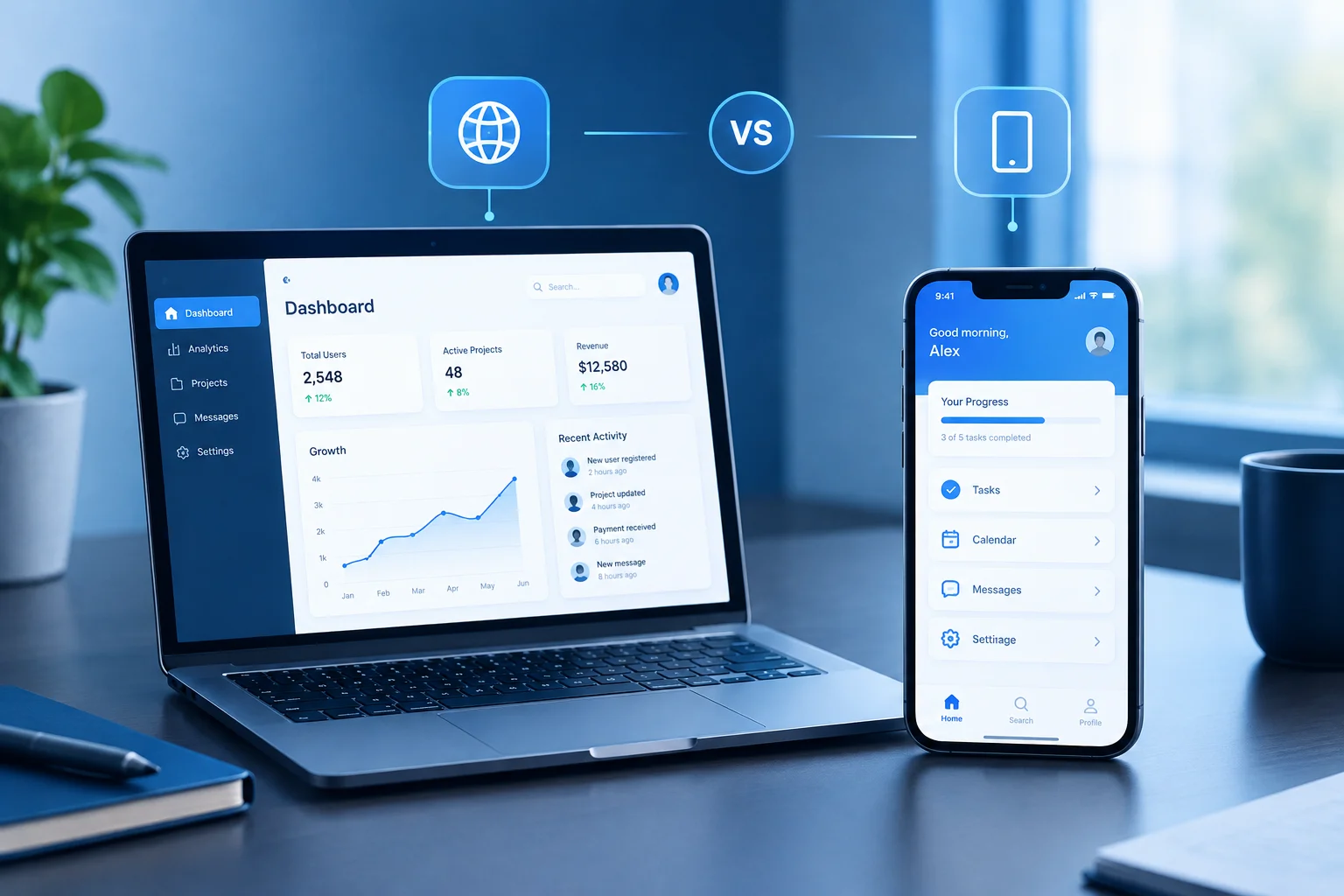
For the unfamiliar, PWAs are web applications that deliver app-like experiences directly through the browser — fast loading, offline functionality, push notifications, and home screen installation — without requiring users to visit an app store or download anything.
That last point is the game-changer. The installation barrier kills engagement for most apps. Studies show that every additional step between a user discovering your product and actually using it causes massive drop-off. PWAs eliminate that friction entirely. Real-world results back this up: companies deploying PWAs have reported conversion increases of 15–169%, bounce rate reductions of up to 60%, and significant revenue gains — all because users can access the app instantly.
PWAs make the most strategic sense in several scenarios. For B2B portals and internal tools, where asking employees or partners to download a native app creates adoption friction. For content platforms and e-commerce sites, where SEO discoverability matters (PWAs are indexable by search engines, native apps are not). And for businesses targeting emerging markets, where users have limited storage space and unreliable connectivity.
PWAs are not a replacement for native apps in every situation. If your app requires deep hardware access — advanced camera controls, Bluetooth LE, or AR capabilities — native development still has the edge. But for the majority of business applications, PWAs deliver 85–95% of native performance at a fraction of the development and maintenance cost.
SoftwareOrbits builds progressive web apps as part of our web development services, and we have seen firsthand how removing the install barrier transforms adoption rates — especially for clients in e-commerce, healthcare, and fintech.
AI Agents Are Moving From Hype to Product
If 2025 was the year everyone talked about AI agents, 2026 is the year they started shipping in real products. An AI agent is software that does not just respond to commands — it plans, executes multi-step tasks, uses external tools, and adapts based on results.
Inside mobile apps, AI agents are beginning to handle workflows that previously required manual user interaction. Think of an agent that monitors your calendar, drafts meeting prep documents from your email threads, and sends follow-up summaries — all without you initiating each step individually.
But the reality check matters here. According to Deloitte’s 2026 Tech Trends research, only 11% of organizations have AI agents in production, despite 38% running pilots. Gartner predicts that 40% of agentic AI projects will fail by 2027 — not because the technology does not work, but because organizations try to automate broken processes instead of fixing them first.
For app developers and business leaders, the practical takeaway is this: AI agents are real and valuable, but they require clean data, well-defined workflows, and careful scoping. Start with narrow, high-value use cases — automating customer support triage, personalizing content feeds, or handling repetitive data entry — before attempting fully autonomous workflows.
Low-Code and No-Code Have Graduated to Production
Low-code and no-code platforms were once dismissed as tools for hobbyists building simple prototypes. That perception is dangerously outdated. Gartner estimates that 75% of new applications will be built using low-code or no-code tools by the end of 2026, up from less than 25% in 2020.
In a survey of over 2,100 companies, 78% are actively developing or planning to develop AI-infused low-code applications within the next year. These are not weekend side projects — they include enterprise workflow automation, internal portals, field operations tools, and customer-facing applications.
The key shift is that modern low-code platforms produce real, exportable code. FlutterFlow generates production-grade Flutter code. Bubble now ships native iOS and Android apps using React Native under the hood. These platforms have evolved from closed, proprietary sandboxes into genuine accelerators that can serve as the starting point for products that eventually scale into fully custom solutions.
The sweet spot for low-code in 2026 is clear: rapid validation of business ideas, internal tool development, workflow automation for non-engineering teams, and MVP creation for startups testing product-market fit. For complex products with unique business logic, performance requirements, or regulatory compliance needs, custom development remains the better path. Smart organizations are combining both — using low-code for speed where it fits, and custom engineering where it matters.
On-Device AI and Edge Computing Change the Game
The next frontier in app development is not about faster cloud servers — it is about making apps smarter without relying on the cloud at all.
On-device AI processes data directly on the user’s smartphone instead of sending it to remote servers. This means faster response times (no network latency), better privacy (data never leaves the device), and reliable functionality even without an internet connection.
Apple’s Core ML, Google’s ML Kit, and Meta’s ExecuTorch are making it increasingly practical to run sophisticated machine learning models directly on mobile devices. Applications that benefit most include real-time image recognition, voice processing, health monitoring, and personalized recommendations — all running locally, all responding instantly.
Edge computing takes this further by pushing processing closer to the data source across the broader infrastructure, not just on the phone itself. For industries like healthcare, logistics, and manufacturing, where latency and data privacy are non-negotiable, edge computing is becoming a core architectural requirement.
For businesses building apps that handle sensitive user data or need to function in low-connectivity environments, on-device AI is no longer a luxury — it is a competitive advantage.
The Tools Shaping the Future of App Development
The tool landscape has evolved dramatically. Here is a snapshot of the most impactful tools across key categories.
Frameworks: Flutter and React Native dominate cross-platform development. Kotlin Multiplatform is gaining ground for shared business logic. Expo has simplified React Native deployment significantly.
AI coding assistants: GitHub Copilot leads in adoption, with deep integration into VS Code. Cursor is gaining popularity for its codebase-aware AI assistance. Google’s Gemini Code Assist offers native Flutter and Dart support. Claude Code provides strong reasoning capabilities for complex architectural decisions.
AI app builders: FlutterFlow for exportable Flutter code with visual building. Bolt.new for multi-framework web app generation. Lovable for fast web MVPs with clean React and TypeScript output. Bubble for complex no-code web and mobile apps.
Backend and infrastructure: Firebase continues to dominate for mobile backend-as-a-service. Supabase is growing rapidly as an open-source Firebase alternative. AWS Amplify and Google Cloud provide scalable infrastructure for enterprise-grade applications.
Design-to-code: Figma remains the standard for design collaboration, with growing AI-to-code pipelines that convert designs into working Flutter or React Native components.
What This Means for Businesses Planning Their Next App
The trends are clear, but the strategic implications depend on where your business sits.
If you are a startup validating an idea, leverage AI app builders and low-code platforms to test your concept before committing to a full custom build. Get a working product into users’ hands in weeks, not months.
If you are a mid-size business expanding digitally, cross-platform development with Flutter or React Native gives you the best return on investment. Build once, deploy on iOS, Android, and web — and consider a PWA if your use case fits.
If you are an enterprise modernizing legacy systems, invest in platform engineering, API-first architecture, and cloud-native infrastructure. AI agents and automation can deliver significant efficiency gains, but only if your underlying systems and data are clean.
Regardless of size, do not treat AI as optional. Whether it is an AI assistant helping your developers ship faster or an AI-powered feature making your product smarter, the organizations that integrate AI thoughtfully will outpace those that wait.
Frequently Asked Questions (FAQ)
What is the biggest trend in app development in 2026?
AI integration at every level — from AI-powered development tools that help engineers write code faster, to AI agents embedded inside applications that automate tasks for users. AI is reshaping both how apps are built and what apps can do.
Is native app development still relevant?
Yes, but for a narrower set of use cases. Native development remains the best choice for apps that need deep hardware access, maximum performance (gaming, AR/VR), or platform-specific capabilities. For most business applications, cross-platform frameworks like Flutter and React Native deliver equivalent results at lower cost.
Should my business build a PWA or a native app?
It depends on your use case. PWAs are ideal for content-heavy platforms, e-commerce, B2B tools, and internal applications where removing the install barrier drives adoption. Native apps are better for consumer apps that require offline-heavy features, advanced device capabilities, or an app store presence for discoverability.
Are no-code and low-code platforms reliable for production apps?
Increasingly, yes. Modern platforms like FlutterFlow and Bubble produce exportable, production-grade code. They are well-suited for MVPs, internal tools, and workflow automation. For highly complex or performance-critical applications, custom development is still recommended.
How long does it take to build a mobile app in 2026?
Timelines vary significantly. A simple MVP using AI tools and low-code platforms can be ready in 2–4 weeks. A custom cross-platform app with moderate complexity typically takes 3–6 months. Enterprise applications with complex integrations can take 6–12 months or more.
What programming language should I learn for app development?
Dart (for Flutter) and JavaScript/TypeScript (for React Native) are the most versatile choices in 2026. Both give you access to cross-platform development and have strong AI tooling support. Kotlin is worth learning if you are focused on Android-first or KMP-based shared logic architectures.
Conclusion
App development in 2026 is faster, more accessible, and more powerful than it has ever been. AI is transforming both the development process and the products themselves. Cross-platform frameworks have eliminated the need to choose between iOS and Android. Progressive Web Apps are removing friction for millions of users. And the tools available to developers today — from intelligent code assistants to full app generators — would have seemed like science fiction just five years ago.
But faster tools do not eliminate the need for smart strategy. Choosing the right framework, the right architecture, and the right development approach still requires experience, technical judgment, and a clear understanding of your business goals.
If you are planning a mobile app, web application, or digital product and want expert guidance on choosing the right technology stack, SoftwareOrbits can help. Our development teams specialize in mobile app development, web development, and custom software solutions — built with the frameworks and tools that define modern app development. Reach out for a free consultation to discuss your project.