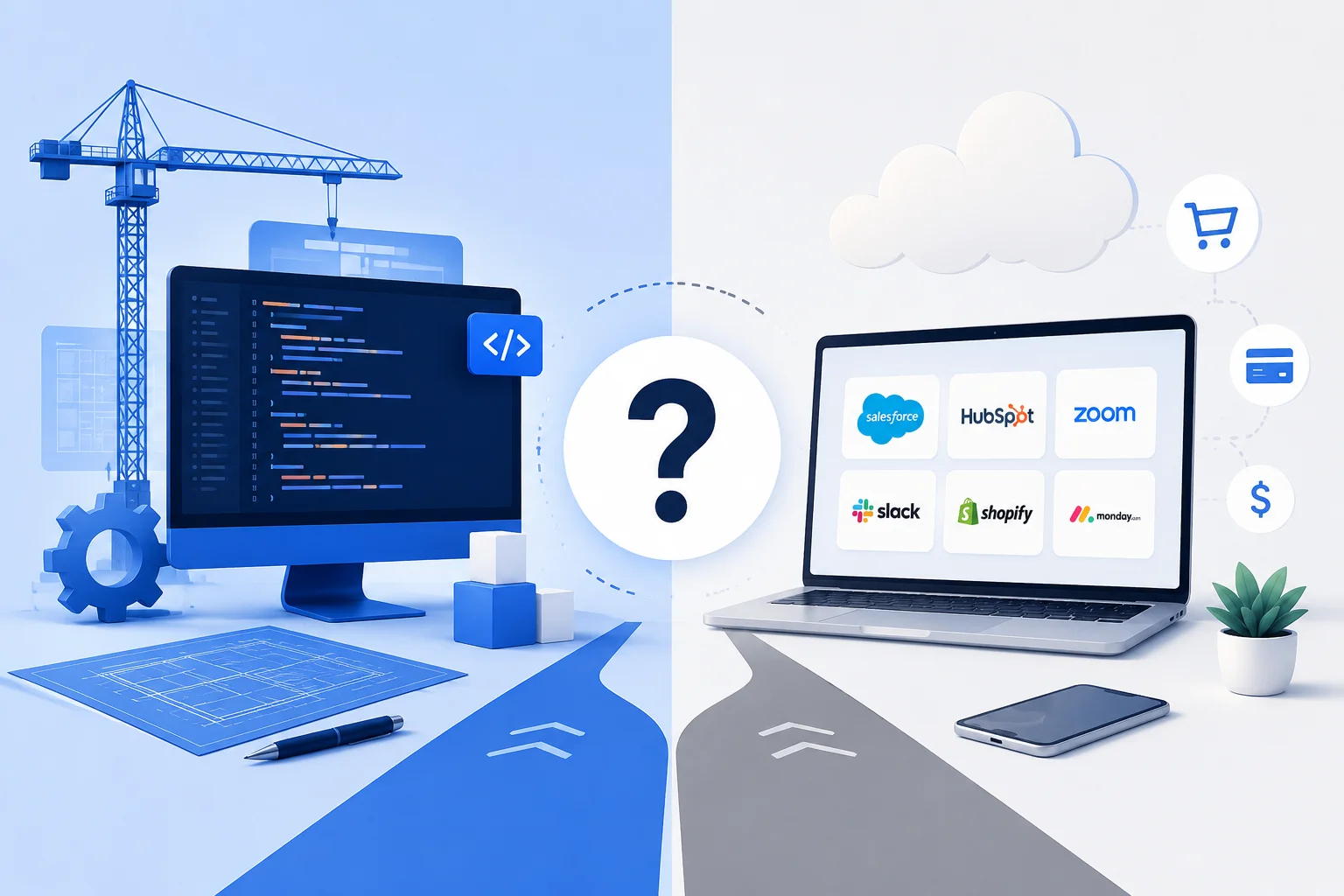
The native vs cross platform app development decision comes down to one trade-off. Native apps, built separately for iOS and Android, deliver the strongest performance and deepest platform integration. Cross platform apps share one codebase, so they cost less and ship faster. In 2026, cross platform fits most business apps; demanding apps still justify native.
We build both, so we have no framework to sell you. We wrote QUITTR natively for iOS and Android, and we ship Flutter and React Native apps for clients every month. That mix has taught us where each approach earns its cost and where it quietly burns money. This guide lays out the real differences, the numbers behind them, and a decision framework you can apply to your own app in about ten minutes.
What Is the Difference Between Native and Cross Platform App Development?
Native development means writing two separate apps: one in Swift for iOS (Apple’s programming language) and one in Kotlin for Android (Google’s). Cross platform development means writing one app in a framework like Flutter or React Native that runs on both operating systems from a single codebase.
The practical consequences follow from that single fact. Two native codebases mean two sets of engineers, two code reviews for every feature, and two apps that can drift apart if the teams don’t coordinate. One cross platform codebase means one team, one feature implemented once, and near-perfect consistency between the iOS and Android versions.
What you give up with the shared codebase is directness. A native app talks to the operating system with nothing in between, so every new iOS or Android capability is available the day it ships. A cross platform app works through a translation layer, and when Apple or Google releases something new, you wait for the framework to support it or write a native bridge (a small piece of platform-specific code connecting the framework to the OS) yourself.
A quick note on the word “hybrid.” Older articles use native vs hybrid app comparisons, where hybrid meant a website wrapped in an app shell using tools like Cordova or Ionic. Those wrappers earned their reputation for sluggishness. Modern cross platform frameworks compile to real native components and perform in a different league, so if you last researched this question in 2019, the ground has shifted.
The stakes are worth the deliberation. Sensor Tower’s State of Mobile 2026 report puts 2025 consumer spending on iOS and Google Play at $167 billion, up 10.6% year over year, across nearly 150 billion downloads. Mobile is where your users already are; the only question is what to build for them.
Native vs Cross Platform App Development: How Do They Compare?
Cross platform wins on cost, speed, and consistency; native wins on performance, platform depth, and long-term flexibility. Here is the full picture:
| Dimension | Native (Swift + Kotlin) | Cross platform (Flutter / React Native) |
|---|---|---|
| Codebases to maintain | Two | One |
| Performance | Best possible; no translation layer | Close to native for most apps; gaps appear in heavy animation, games, real-time processing |
| Look and feel | Perfectly matches each platform | Very good; occasional subtle differences from platform conventions |
| Access to new OS features | Day one | After framework support, or via custom bridges |
| Team required | iOS and Android engineers | One team covering both platforms |
| Time to launch both platforms | Longest; two builds in parallel or sequence | Fastest; one build ships twice |
| Relative cost | Highest | Meaningfully lower for two platforms |
| App size | Smallest | Larger; the framework ships inside the app |
| Best for | Games, hardware-heavy apps, platform-specific polish | Business apps, MVPs, e-commerce, content, most consumer apps |
The developer market matters as much as the technology. Stack Overflow’s 2025 Developer Survey found 10.8% of developers working in Kotlin and just 5.4% in Swift, which is one reason senior iOS engineers are expensive and slow to hire. Cross platform pools are healthier: in Stack Overflow’s 2024 survey, 9.4% of developers reported working with Flutter and 8.4% with React Native. When one team covers both platforms, the hiring problem shrinks by half.
Is Native App Development Better Than Cross Platform?
Native app development is better at specific things, not better in general. It is the right call when your app’s core value depends on what native does best, and expensive overkill when it doesn’t.
Native earns its price in five situations. Games and graphics-intensive apps need every frame the hardware can produce. Apps built around device hardware, such as advanced camera pipelines, Bluetooth medical devices, or AR (augmented reality, where digital objects overlay the camera view), hit framework limits quickly. Apps that must adopt new OS features on launch day, the way widget-heavy or watch-companion apps do, cannot wait for framework support. Apps where micro-interactions are the product, with complex gesture-driven animation, feel measurably crisper native. And apps under strict performance budgets, like real-time audio or video processing, have no room for a translation layer.
We made exactly this call with QUITTR, a wellness app we built natively in Swift and Kotlin. The product depends on smooth, emotionally engaging animation and tight platform integration, and it now serves more than 2 million users and has been featured in The New York Times and Men’s Health. Native was the right choice for that app. It would be the wrong choice for most of the client apps we ship, which is the honest part most agency blogs leave out.
The performance gap deserves honest sizing too. For a typical business app, screens, forms, lists, payments, and notifications, users cannot tell a well-built Flutter app from a native one. The difference shows up at the edges: startup time on old Android devices, very long lists scrolling under load, animation running while data syncs. If your app lives at those edges, go native. If it doesn’t, you are paying double to solve a problem you don’t have.
When Should You Choose Cross Platform App Development?
Choose cross platform app development when you need both platforms, your app is not performance-extreme, and your budget or timeline is finite. That describes most apps being built in 2026.
The economics are hard to argue with. One codebase means one team building each feature once, which in our projects typically cuts the combined cost of shipping on both platforms by a third or more compared with two native builds, and cuts calendar time similarly. Every feature after launch inherits the same saving: one implementation, one test cycle, one release. For a startup validating an idea, that difference often decides whether there is enough runway left to reach the next milestone. Our mobile app development cost guide breaks down where the money actually goes.
Consistency is the quieter benefit. With two native teams, iOS and Android versions drift: a feature ships on one platform first, a bug exists on one but not the other, and product management spends real energy keeping parity. A shared codebase makes parity automatic.
The framework choice inside the cross platform decision matters less than founders fear. Flutter offers superb UI control and consistency; React Native lets JavaScript and React teams reuse existing skills, and both are mature, widely adopted, and backed by Google and Meta respectively. We compared them head to head in our Flutter vs React Native guide, but the short version is that either will serve a standard business app well, and your team’s existing skills should usually tip the scale.
One more question founders often bundle in here: whether to skip one platform entirely. If your audience is heavily concentrated on one OS, launching iOS-first or Android-first as a native app can beat a cross platform launch on both. Our iOS vs Android analysis covers when a single-platform start makes sense.
How Much Does Native vs Cross Platform Development Cost?
Cross platform costs meaningfully less whenever you need both iOS and Android, because you are paying for one build instead of two. Based on the projects we scope and the quotes founders share with us, here is how the approaches compare for typical app tiers; treat these as market observation from our own pipeline, not audited industry data:
| App complexity | Cross platform (both platforms) | Native (both platforms) | Typical timeline difference |
|---|---|---|---|
| Simple MVP (auth, profiles, core flow) | $25K–$60K | $40K–$100K | Cross platform 1–2 months faster |
| Mid-complexity (payments, chat, integrations) | $60K–$150K | $100K–$250K | Cross platform 2–3 months faster |
| Complex (real-time features, heavy backend) | $150K–$300K | $250K–$500K+ | Cross platform 3+ months faster |
Three things this table hides. First, native costs scale with parity: if you only ever ship iOS, native costs roughly the same as cross platform, and the comparison disappears. Second, maintenance follows the same ratio as the build, since every future feature and OS update is done once or twice; over a five-year life, the maintenance gap usually exceeds the original build gap. Third, a bad team erases every framework advantage. A well-architected native pair of apps is cheaper to run than a poorly built Flutter app, which is why vetting mobile app development services matters more than the technology decision itself.
Budget for the exceptions as well. Cross platform apps sometimes need native modules for platform-specific features, written by an engineer with native skills. Plan for a small percentage of the codebase to be native bridges, and for occasional framework upgrade work when Flutter or React Native releases a major version.
When Is Cross Platform the Wrong Choice? (And When Is Native?)
Both approaches fail predictably when applied to the wrong problem, and it is worth being blunt about the failure modes on each side.
Cross platform is the wrong choice when performance is the product. If you are building a game, a real-time audio tool, a camera-first app, or anything that must squeeze the hardware, the translation layer will eventually become the bottleneck, and teams in that position end up rewriting native anyway, having paid for the app twice. It is also the wrong choice when your roadmap depends on adopting each new iOS and Android capability the week it ships, and when your app must integrate deeply with platform ecosystems like widgets, watch apps, car interfaces, and system-level extensions, where framework support consistently lags.
Native is the wrong choice when your constraint is money or time and your app is functionally standard. Paying for two codebases to build what is essentially forms, lists, and API calls doubles cost for a difference your users will never perceive. It is also risky when you can only hire or afford one platform team, because launching iOS-only while Android waits a year hands competitors half the market, and when your product is still unvalidated, since burning runway on platform polish before you know anyone wants the product is the classic startup mistake.
There are also cases where neither is right. If your users reach you through a browser anyway, a responsive web app or PWA (progressive web app, a website installable like an app) may make a mobile app unnecessary for now. We turn away app projects on this basis several times a year; a product that should have been a website makes a bad app no matter the framework.
What About Kotlin Multiplatform and Other Options in 2026?
The two-option framing is getting less accurate, and a 2026 decision should at least glance at the middle paths:
| Option | What it is | When it fits |
|---|---|---|
| Kotlin Multiplatform (KMP) | Shares business logic in Kotlin while keeping fully native UI on each platform | Teams that want native look and feel but hate writing logic twice; strong Android teams |
| .NET MAUI | Microsoft’s cross platform framework using C# | Companies with existing .NET teams and Microsoft infrastructure |
| PWA | An installable website with app-like behavior | Content, catalogs, and tools where discovery happens on the web and device features are minimal |
Kotlin Multiplatform is the one to watch. It splits the difference genuinely: your networking, data, and business rules live in one shared codebase, while each platform keeps a real native interface. The cost lands between pure native and pure cross platform, and Google’s official support has made it a serious contender for teams that would otherwise default to two full native builds. For most startups it is still a more specialized path than Flutter or React Native, mostly because the hiring pool is smaller, but for companies with existing Android expertise it deserves a real evaluation.
None of these change the core logic of the decision. They widen the menu, and the framework below handles them the same way.
How Do You Decide? A Step-by-Step Framework
Work through these six questions in order; most teams reach a clear answer before the end:
- Does your app’s core value depend on extreme performance, heavy graphics, or deep hardware access? If yes, go native and stop here. Everything else is secondary to the product working.
- Do you need both iOS and Android within the first year? If no, build native for your single target platform; the cross platform advantage mostly evaporates for one OS. If yes, continue.
- Is your budget or timeline the binding constraint? If yes, cross platform is almost certainly your answer. One build for two platforms is the biggest cost lever available to you.
- Does your existing team have relevant skills? React and JavaScript experience points to React Native; strong Kotlin experience makes Kotlin Multiplatform worth evaluating; no mobile experience at all points to whichever framework your development partner is strongest in.
- Will your app rely on day-one adoption of new OS features? If yes, weight the decision back toward native, or plan a real budget for native bridge work inside a cross platform app.
- Can you afford to maintain what you build? Whatever you choose, model five years of updates, not just the launch. Two codebases cost roughly twice as much to keep alive, forever.
If the answers conflict, weight question 1 highest and question 3 second. An app that cannot deliver its core experience fails regardless of budget, and a company that runs out of money fails regardless of frame rate.
Frequently Asked Questions
What is the difference between native and cross-platform app development?
Native development builds separate apps for iOS (in Swift) and Android (in Kotlin), each talking directly to its operating system. Cross-platform development builds one app from a single codebase, using a framework like Flutter or React Native, that runs on both. Native maximizes performance and platform integration; cross-platform minimizes cost and time by building once.
Is cross-platform app development cheaper than native?
Yes, when you need both iOS and Android. One codebase means every feature is built, tested, and maintained once instead of twice; in our projects that typically reduces combined cost by a third or more, with similar timeline savings. If you only need one platform, the cost difference largely disappears and native becomes the simpler choice.
Which is better for startups: native or cross-platform?
Cross-platform, in most cases. Startups need to validate a product on both platforms before the money runs out, and one codebase gets an MVP in front of iOS and Android users fastest. The exceptions are startups whose product is the performance: games, camera-first apps, and real-time tools, which should start native despite the cost.
Do cross-platform apps feel slower than native apps?
Not for typical business apps. Modern Flutter and React Native apps render real native components and are indistinguishable from native for screens, lists, forms, and payments. Differences appear under stress: heavy animation, very large lists, old low-end devices, and real-time processing. If your app lives in those conditions, native still holds a real advantage.
Can you switch from cross-platform to native later?
Yes, and the path is usually gradual rather than a rewrite. Teams typically move performance-critical screens to native modules first, keeping the shared codebase for everything else. A full rewrite only makes sense when the app’s core has outgrown the framework. Building cross-platform first and migrating hot spots later is a legitimate, common strategy, not a failure.
What is Kotlin Multiplatform and is it ready in 2026?
Kotlin Multiplatform (KMP) shares business logic, networking, and data code across platforms while keeping fully native user interfaces. It is production-ready and officially supported by Google, and it suits teams that want native UI quality without writing logic twice. The hiring pool remains smaller than Flutter’s or React Native’s, so for most startups it is the specialist’s choice rather than the default.
How long does it take to build a native vs cross-platform app?
A mid-complexity cross-platform app typically takes four to seven months to launch on both platforms; the same app built natively takes roughly six to ten, since two codebases are developed in parallel or sequence. Complexity, integrations, and design scope move these numbers more than the framework choice does, and post-launch iteration continues indefinitely either way.
Is a hybrid app the same as a cross-platform app?
Not anymore. Hybrid traditionally meant a website wrapped in an app shell (Cordova, Ionic), which performed poorly and gave the category a bad name. Modern cross-platform frameworks like Flutter and React Native compile to real native components with near-native performance. When comparing options in 2026, treat old hybrid-app criticism as outdated evidence against today’s cross-platform tools.
Still Deciding? Get a Straight Answer
The cheapest time to get this decision right is before the first line of code, and it costs nothing to sanity-check your thinking. Send us your app idea and constraints, and we will tell you plainly which approach fits, including when the answer is the one that earns us less. Book a free consultation and bring your roadmap.