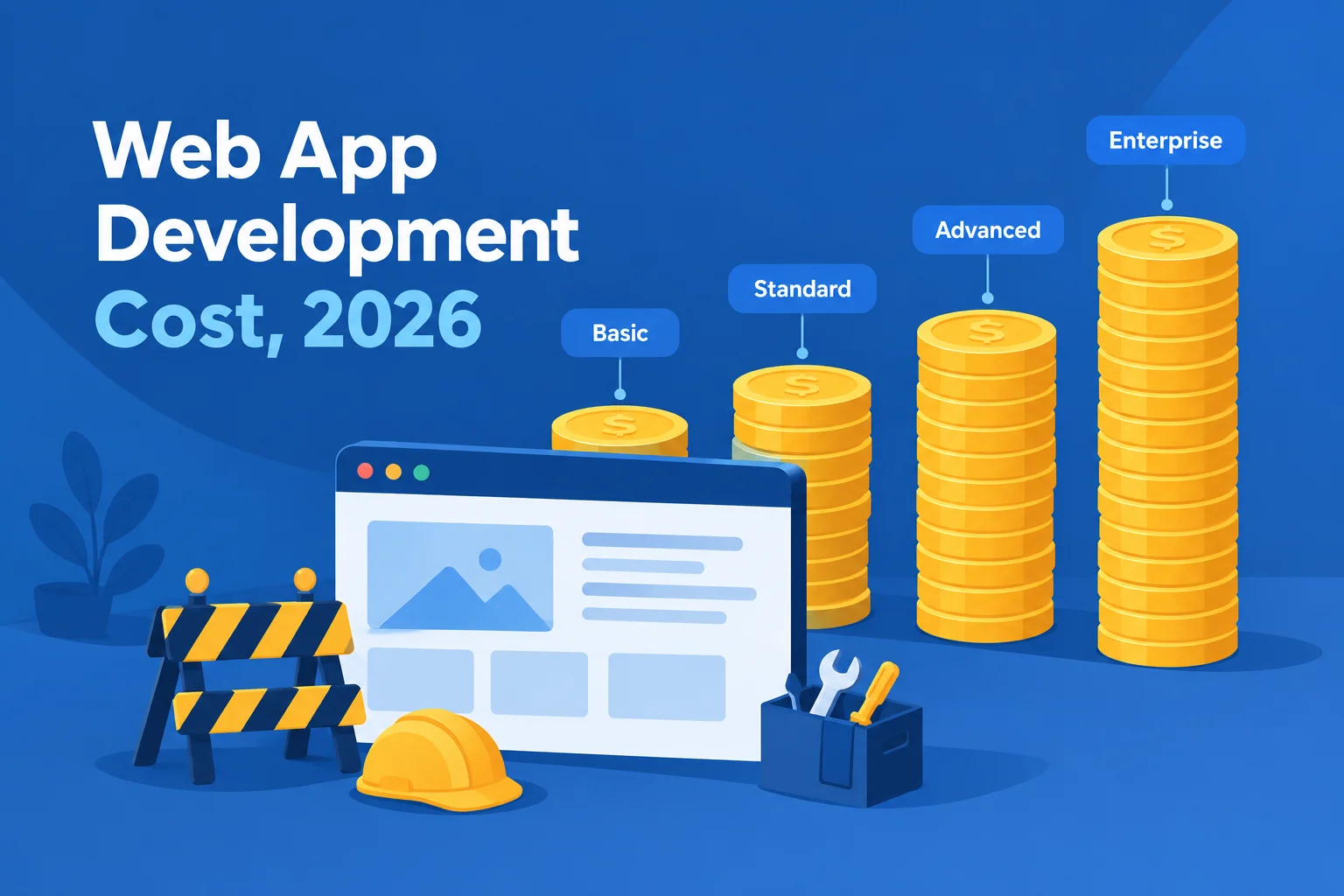
Web app development costs $15,000 to $60,000 for a simple product, $60,000 to $150,000 for a standard business application, and $150,000 or more for complex platforms in 2026. The main drivers are feature scope, integrations, design depth, and who builds it. The ranges in this guide come from real project quotes, not scraped averages.
Price is also the most abused number in this industry, quoted low to win the deal and grown through change orders, or padded high because the buyer could not tell a web app from a website. Both failure modes have the same cure: understanding what actually generates the cost. We quote web builds every week through our web development services, and this guide shows you the tiers we use, what sits inside each number, and the questions that expose a quote you should not sign.
How Much Does a Web App Cost in 2026?
Most business web apps land between $60,000 and $150,000 when professionally built; simpler products and validation builds sit well below that, and platform-scale systems sit above it. These are the bands we quote in our own pipeline, one firm’s market observation rather than audited industry data:
| Tier | What it is | Typical range | Timeline |
|---|---|---|---|
| Simple web app | Accounts, one core workflow, standard design: an internal tool, a booking product, a basic portal | $15K–$60K | 6–12 weeks |
| Standard business app | Payments, roles and permissions, several integrations, admin panel, custom design | $60K–$150K | 3–5 months |
| Complex platform | Marketplaces, SaaS with billing tiers, real-time features, heavy data, compliance | $150K–$400K+ | 5–9 months |
The spread inside each tier is doing real work. A $70,000 quote and a $130,000 quote for “the same” standard app usually differ in integrations count, design custom-ness, and how much admin tooling the operating team gets, which is why comparing quotes without comparing scope documents tells you nothing. Broader context for how these numbers relate to software pricing generally is in our guide to the cost to build custom software; web apps occupy the lower-to-middle stretch of that spectrum because they skip app store overhead and multi-platform builds.
Spending pressure is not easing around you either: the latest Gartner IT spending forecast has worldwide software spending reaching $1.47 trillion in 2026, up 15.5% year over year. Development capacity stays in demand, which keeps rates firm and makes scope discipline, not vendor haggling, the buyer’s real cost lever.
Web App vs Website: Why Is the Price So Different?
A website presents information; a web app does things, and that difference is most of the price gap. A marketing website, pages, forms, a blog, typically costs $3,000 to $15,000. A web app has accounts, logic, and data that changes with every user action, and it starts around $15,000 for even modest scope.
The gap makes sense once you see what the app adds: a backend (the server-side engine that enforces rules and processes data), a database designed for your domain, authentication and security, and states the marketing site never faces, errors, payments mid-failure, two users editing the same record. Testing multiplies accordingly. A brochure site is reviewed; an application is engineered.
This is also the most common quote-comparison mistake we see. A founder collects a $9,000 “website with login” bid and a $60,000 web app bid and assumes the second vendor is gouging, when they are pricing different species. The $9,000 build is a website wearing an app costume, and it collapses the first time real workflow lands on it. If your product’s value is in what users can do rather than what they can read, budget in app terms from the first conversation.
What Drives Web App Development Cost?
Six drivers explain nearly every quote, and every one is partly in your control:
- Feature scope. The dominant driver, as always. Each workflow carries design, logic, edge cases, and testing. Cutting to one core flow is where affordable builds come from; feature lists longer than a page are where budgets go to grow.
- Integrations. Every external system, payments, email, CRM, accounting, maps, adds connection work and error handling. Two or three are routine; eight is a budget event.
- Roles and permissions. An app where everyone sees everything is simple. Add customer, staff, and admin views with different rights, and logic, testing, and security all multiply. This single driver separates many $40K quotes from $90K ones.
- Design depth. Clean, component-based interfaces cost a fraction of fully custom branded design with animation. B2B tools rarely need the latter; consumer products competing on feel sometimes do. Our UI/UX design services work sits in both modes, and the right one is a strategy question, not a taste question.
- Data complexity. A product storing profiles and bookings is one class of problem; one crunching analytics across millions of rows, syncing external feeds, or serving real-time updates is another. Founders underestimate this driver most because it is invisible in screenshots.
- Who builds it. Freelancers, agencies, and in-house teams price differently, and region moves rates several-fold. This driver deserves its own section below.
Notice what is missing again: novelty of idea. You pay for implementation complexity, not originality, and a clever product with modest mechanics is one of the cheapest things we build.
Where Does the Web App Budget Actually Go?
A healthy budget splits into predictable slices, and the split doubles as a fraud detector when a quote hides rows:
| Budget slice | Share | What it covers |
|---|---|---|
| Discovery and scoping | 5–10% | Requirements, user flows, technical decisions |
| UX/UI design | 10–20% | Wireframes, screens, interaction patterns |
| Frontend development | 25–30% | Everything users see and touch in the browser |
| Backend development | 30–35% | Logic, database, APIs, security, integrations |
| Testing and QA | 10–15% | Real-device, real-data verification |
| Launch and infrastructure | ~5% | Deployment, monitoring, hosting setup |
The backend share surprises founders because the money goes where the screenshots aren’t. Users judge the frontend; the product survives on backend development, which is where payments stay correct, data stays consistent, and security actually lives. A quote weighted overwhelmingly toward visible screens is a quote for a demo, not a product.
To make the shares concrete, here is how a typical $90,000 standard-tier build distributes in our pipeline: about a week and a half of discovery producing a written scope (~$7K), three weeks of design across fifteen-odd screens (~$14K), backend work covering accounts, roles, payments, two integrations, and the data model (~$30K), the frontend that puts it all in the browser (~$24K), two and a half weeks of QA across browsers and devices (~$11K), and launch infrastructure (~$4K). No single line looks dramatic, which is the point: web app cost is an accumulation of ordinary competence, and quotes dramatically below the sum are usually missing lines rather than beating them.
One driver founders ask about that barely matters: the technology stack. Whether the team builds in React, Vue, Laravel, Django, or Rails moves a quote far less than any driver above, because mainstream stacks are all productive in experienced hands. The stack question worth asking is not “which one” but “how mainstream”: an unusual stack costs nothing today and plenty later, when every future developer who touches the product needs to be a specialist.
The same table prices the classic corner-cuts. Skipping discovery saves 8% now and pays it back several-fold in change orders; skipping QA converts launch week into a public bug tracker. We built APSONE, a business management web app, on exactly the opposite bet: unglamorous shares spent where the operating company would feel them for years.
How Do Team Choices Change the Price?
The same app varies two-to-threefold by who builds it. A US agency team bills $75 to $150 per hour; nearshore and Eastern European teams bill $30 to $70 for comparable seniority; solo freelancers undercut both. In-house looks different again: per the BLS wage data for software developers, the median US developer earns $133,080 in salary, and with benefits at 30.1% of total compensation per the BLS employer cost figures, plus recruiting and tooling, a single hire runs roughly $200,000 a year, which only makes sense when there is a roadmap measured in years, not a build measured in months.
The honest guidance per option. Freelancers fit simple-tier builds with tight scope and a technical buyer who can review the work; the risk is concentration, one person holding your whole product. Agencies fit standard and complex tiers, where you are buying process, redundancy, and accountability alongside code. In-house fits companies past validation with continuous product work. And blended models, senior architecture with efficient delivery rates, are how most professional web apps actually get built in 2026, including ours.
Rate is also the worst single number to optimize. A $35-per-hour team that needs three rewrites bills more than a $70-per-hour team that ships once, and the cheapest bid’s most common hidden line is your own time, spent managing what the price left out.
Has AI Made Web App Development Cheaper?
Yes, visibly, and the savings are already inside 2026 quotes rather than waiting in the future. AI coding tools are now standard equipment: Stack Overflow’s 2025 Developer Survey found 84% of developers using or planning to use them, with 51% of professionals using them daily. On our projects they compress the repetitive middle, standard screens, boilerplate, test scaffolding, first-pass integrations, which is a real share of any web build.
What has not compressed: deciding what to build, designing flows users understand, the hard 20% of backend logic where products actually differ, and reviewing generated code, which arrives fast and subtly wrong often enough that the same survey found more developers distrusting its accuracy (46%) than trusting it (33%). The net effect in our pipeline: standard-tier apps that would have quoted 30 to 40 percent higher three years ago, and timelines shorter by several weeks, but nothing resembling the AI-built-app-for-$2,000 pitch. Teams selling that are selling the demo; the gap appears when real users arrive.
What Ongoing Costs Should You Expect?
Plan for 15 to 25 percent of the build cost per year, plus a modest monthly infrastructure bill. Hosting, databases, monitoring, and email services for a standard business app typically run a few hundred dollars monthly at early scale, growing with usage rather than time. The larger line is engineering attention: dependency updates, security patches, small fixes, and the improvement list your first users generate.
Two framing corrections save later grief. First, a growing maintenance budget is a success signal, not a failure of the original build; traction generates feature demand, and funding it from validated revenue is the good version of this expense. Second, zero-maintenance plans do not produce zero costs; they defer them into a rescue project with interest. The web app you stop maintaining ages exactly like the legacy system you built it to replace.
Budget one more line that most first-time buyers miss entirely: your own team’s time. Someone on your side owns decisions, reviews progress, tests features against reality, and answers the dozens of small questions that keep a build moving. On a standard-tier project that is several hours a week from a person with authority, and builds where nobody on the client side has that time run over schedule far more often than builds with technical challenges do.
When Is a Cheap Web App Expensive, and When Are You Overpaying?
Both directions of pricing error are common, and honesty requires naming ours first: sometimes you should not hire a firm like us at all.
You are probably overpaying if your need is a marketing site with a form, which is a website budget, not an app budget; if an off-the-shelf SaaS tool covers 80% of the workflow for $100 a month, where the five-year math in our custom software vs SaaS comparison usually favors renting; or if a vendor is quoting platform-tier prices for simple-tier scope because nobody wrote the scope down.
The cheap build turns expensive when the architecture cannot survive success. The pattern arrives in our inbox monthly: a $12,000 build that worked as a demo, buckled at real usage, and needs discarding rather than extending, making the true cost the original spend plus the rebuild plus the lost months. It also turns expensive through missing rows, no QA line, no discovery, no documentation, each of which converts into your time and your users’ patience. And it turns expensive silently through security shortcuts, which price themselves only once, at the worst possible moment.
The test that catches most of it: ask what happens at twice the users and twice the data, and ask to see the QA and documentation lines in the quote itself. Vendors building products answer specifically, because they have already thought about your app at scale; vendors building demos change the subject, because the demo was always the deliverable. Five minutes of these questions routinely saves five figures of rebuild.
How Do You Get an Accurate Web App Quote?
Accurate quotes are made by buyers, not vendors, and the making takes about a week:
- Write the one-page scope. The core workflow, the user types, the integrations, and what “done” means. Our guide to writing a software requirements document shows the format; without this page, every quote you collect prices a different imaginary product.
- Mark must-have versus later. A two-column list halves most first quotes, because vendors price everything you mention.
- Collect two or three comparable bids. Same scope document to each, so differences reveal the vendor rather than the guesswork.
- Interrogate the smallest bid. Ask which table rows it skips: discovery, QA, documentation, admin tooling. Cheap is fine; incomplete pretending to be cheap is the trap.
- Ask the scale and risk questions. What breaks at 10x usage, what is the number one estimate risk, and what happens at 120% of budget. Specific answers signal a real plan.
- Check shipped work, not decks. Two references on projects resembling yours beat any portfolio page.
Frequently Asked Questions
How much does it cost to build a web app in 2026?
Simple web apps run $15,000 to $60,000, standard business applications $60,000 to $150,000, and complex platforms $150,000 and up, based on the quotes in our own pipeline. Feature scope, integrations, permissions complexity, and team choice drive the position within each band. Add 15 to 25 percent of the build cost per year for maintenance.
How long does web app development take?
Six to twelve weeks for a simple app, three to five months for a standard business application, and five to nine for complex platforms, from kickoff through launch. Discovery and design consume the first weeks regardless of tier. The most common delay is undecided requirements rather than slow engineering, which is why a written scope shortens calendars more than added developers do.
What is the difference between website cost and web app cost?
A website presents information and typically costs $3,000 to $15,000; a web app executes workflows, with accounts, logic, payments, and a database, and starts around $15,000 even for modest scope. The gap pays for the backend engine, security, and the error states applications must survive. If users log in and do things, budget in app terms.
Can I build a web app for under $10,000?
Only in specific shapes: a no-code build validating demand, a single-workflow internal tool with template design, or a very tightly scoped freelancer project with a technical buyer reviewing the work. What under $10,000 does not buy is custom-engineered software with payments and roles that survives real usage; quotes promising that are deferring the cost, not removing it.
Is a web app cheaper than a mobile app?
Usually, and often by half or more. One responsive codebase serves every device with no app store overhead, while mobile adds platform builds, store review, and slower release cycles; two mobile platforms roughly doubles the gap. That economy, plus search discoverability, is why most products that could be either should build the web version first.
How much does web app maintenance cost per year?
Plan 15 to 25 percent of the original build cost annually as the healthy floor, covering updates, security patches, bug fixes, and small improvements, plus a few hundred dollars monthly in hosting and services at early scale. Successful apps exceed the floor because users generate feature demand, which is the good version of this expense.
What is the cheapest way to build a web app?
Cut scope, not corners: one core workflow, template-based design, standard technology, and a no-code or concierge version first when the goal is validating demand. Then spend properly on what remains, including QA and discovery. The expensive path is the falsely cheap one, a bargain build whose architecture needs discarding at the first sign of traction.
How much does it cost to build a SaaS web app?
SaaS products sit in the standard-to-complex bands, typically $80,000 to $250,000 in our pipeline, because subscription billing, multi-tenancy (one system safely serving many customer organizations), roles, and an admin layer are inherent to the model rather than optional features. A single-tenant MVP for design partners can start smaller and grow into the full architecture with revenue.
Conclusion
Ranges end where your feature list begins, and turning one of those into the other takes a single conversation, not a signed contract. Send us the workflow your app must nail and the tools it must talk to, and we will place it in a tier honestly, including when the answer is “that’s a website” or “rent it instead.” Book a free consultation and plan around a number that survives contact with the build.