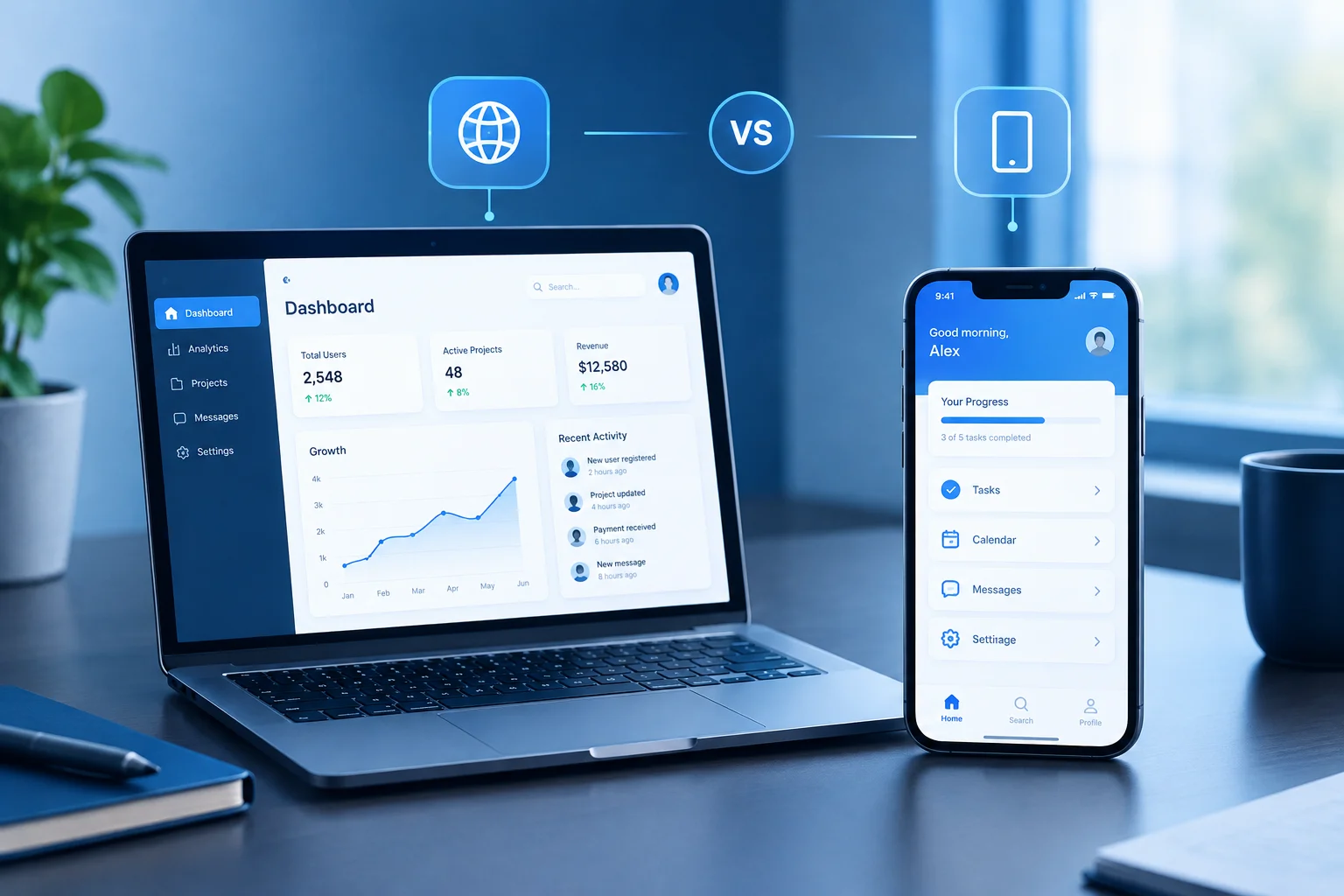
For most products, build the web app first: it costs less, ships faster, works on every device, and is discoverable through search with no app store between you and users. Build mobile first when your product depends on daily habits, push notifications, camera or GPS, or offline use. Many successful products do both, in that order.
The web app vs mobile app question is really a question about your first hundred users: where they will find you, how often they will return, and what the product needs from their device. We build both sides of this line, web platforms and mobile apps, so we have no format to sell you, and the honest pattern from our own project history is lopsided: most founders who arrive certain they need an app actually need a web product first, and a meaningful minority need exactly the opposite. This guide is the sorting logic.
What Is the Difference Between a Web App and a Mobile App?
A web app runs in the browser and needs no installation; a mobile app is installed from an app store and runs directly on the phone. That one difference cascades into everything else: how users find you, what the product can do, and what it costs to build and maintain.
Three formats actually compete for your first build, not two. A responsive web app is a website with real functionality, accounts, payments, dashboards, that adapts to any screen, from desktop to phone. A native or cross-platform mobile app is installed software with full access to the device: push notifications, camera, GPS, offline storage, home-screen presence. Between them sits the PWA (progressive web app), a web app that users can install to their home screen, with offline support and deeper device integration than a plain website; Google’s progressive web app documentation covers what the format can reach, and we return to it below because it changes the decision for a whole class of products.
One misconception clears up half the confusion: a web app is not the lesser product. Most of the software businesses run on, CRMs, dashboards, booking systems, e-commerce checkouts, are web apps, used happily every day from phones and laptops alike. The question is not which format is more serious; it is which distribution and capability profile fits your product’s first year.
Web App vs Mobile App: How Do They Compare?
Web wins on reach, cost, and speed of iteration; mobile wins on engagement, device power, and daily presence. The full picture:
| Factor | Web app | Mobile app |
|---|---|---|
| Works on | Every device with a browser | The platforms you build for |
| Installation | None; click a link | App store download |
| Discovery | Google search, links, sharing | App store search, then everything else |
| Updates | Instant for every user | Release cycles and store review |
| Push notifications | Limited, especially on iOS | Full |
| Device features | Partial and improving | Full: camera, GPS, sensors, offline |
| Engagement pattern | Intentional visits | Habitual, notification-driven |
| Gatekeepers | None | App store rules and revenue share |
| Relative build cost | Lowest | Higher; platform count multiplies it |
| Best first build for | B2B, SaaS, marketplaces, validation | Habit products, device-dependent products |
The engagement gap is real and worth quantifying, because it is mobile’s strongest argument. Sensor Tower’s State of Mobile 2026 report counted 5.3 trillion hours spent in mobile apps in 2025, roughly 3.6 hours per day per user, with consumer in-app spending reaching $167 billion, up 10.6% year over year. When a product earns a place in that daily rotation, nothing on the web matches the retention.
The same report carries the counterargument founders skip: total downloads grew just 0.8%, to nearly 150 billion. Attention inside apps keeps growing; willingness to install new ones does not. Every mobile-first launch bets that users will cross the install barrier for an unproven product, and that bet fails quietly, in marketing spend, far more often than it fails loudly.
When Should You Build a Web App First?
Build web first when your users arrive with intent: they have a problem, they search, they click, and they need to reach value within seconds of that click. That describes nearly all B2B software, SaaS products, marketplaces, booking and commerce products, and anything bought or evaluated at a desk.
The signals, concretely. Your users find products through Google rather than app store browsing, which makes search the distribution channel and the web the only format search can deliver instantly. Your product is used at work, where a browser tab is the natural home and IT policies make installs friction. Your sales motion includes demos, trials, or shared links, all of which die at an install wall. Your budget is validation-sized: a web MVP costs a fraction of a two-platform mobile launch, and our web development services engagements regularly prove or kill product ideas at a cost no app-store launch can match. Or your product simply has no need for the phone’s hardware, in which case mobile-first buys friction without capability.
There is also a strategic reason the web makes the better laboratory: iteration speed. A web product ships fixes and experiments continuously, to every user at once, with no review queue and no fragmenting versions. Pre-product-market-fit, when you might change the product weekly, that loop is worth more than any native capability.
When Should You Build a Mobile App First?
Build mobile first when the product’s value lives in the phone itself: in its sensors, its constant presence, or the daily habit you intend to build. Web-first would not be a cheaper version of these products; it would be a broken version.
The clear cases. Products whose core loop depends on device hardware, camera-first tools, GPS-driven services, anything reading motion or health sensors, need native access from day one. Products built on habit and timely interruption, habit trackers, messaging, social, daily wellness, live on push notifications, which the web still cannot deliver reliably across platforms, particularly on iOS. Products used offline or in motion, field-service tools, fitness tracking, travel companions, need local storage and resilience the browser does not provide. And products for audiences who live entirely on phones, where the desktop session simply never happens, should meet users in the only place they exist.
QUITTR, the wellness app we built that now serves more than 2 million users, is a clean example of a correct mobile-first call: its value depends on being present at the moment of struggle, on streaks and check-ins woven into the day, and on notifications that arrive exactly when needed. A web version of that product would have been structurally unable to do its job. When your product’s honest description sounds like that, build the app, and the follow-up decisions, platform choice and framework, are covered in our guides to iOS vs Android and native vs cross platform app development.
What About PWAs: The Middle Path?
A PWA gives a web product app-like behavior, installation to the home screen, offline support, and push notifications on most platforms, at web-development cost. For a meaningful class of products, that combination postpones the mobile app question by a year or more, which is exactly the kind of deferral a young company should love.
The honest boundaries: PWA capability on iOS lags Android, notification support there arrived late and remains more limited, and a PWA will never match native for heavy graphics, deep hardware use, or app-store discoverability, for the products where those matter. The store absence cuts both ways: no store review and no revenue share, but also no presence where some audiences browse.
The practical pattern we recommend more than any other: build the responsive web app, invest the modest extra effort to make it a PWA, and let real usage data tell you whether a native app is needed at all. If users install the PWA and beg for better notifications, that is validated demand for the native build. If they do not, you just saved the cost of building and forever maintaining an app nobody was going to install.
What Does Each Cost to Build?
A web-first launch typically costs half or less of a mobile-first launch at equivalent scope, and the gap widens if mobile means both platforms. These are the bands we quote in our own pipeline for a standard MVP with accounts, payments, and one core flow; treat them as one firm’s market observation:
| First build | Typical range | Time to launch | Iteration after launch |
|---|---|---|---|
| Responsive web app | $20K–$60K | 2–3 months | Continuous, instant |
| Web app built as a PWA | $25K–$70K | 2–3 months | Continuous, instant |
| Mobile app (one platform or cross-platform) | $40K–$100K | 3–5 months | Release cycles + store review |
| Web + mobile together | $60K–$160K | 4–6 months | Split across both pipelines |
The bottom row deserves a warning label. Founders often price “both at once” as ambition, but pre-validation it doubles spend while halving iteration speed, since every change now ships through two pipelines. The far cheaper version of “both” is sequential: the web build’s backend, accounts, payments, and business logic all carry into the later mobile app, which arrives as mostly a new frontend funded by proven demand.
How the Decision Plays Out: Three Founders
The same framework, applied to the three products we hear pitched most often. A B2B scheduling SaaS: users will find it through search and referrals, trial it from a work laptop, and nothing in the core loop touches phone hardware, so it launches as a web app, adds PWA installability for the managers who live on their phones, and revisits native only if usage data demands it. A social fitness product built on daily streaks and nudges: the thesis is the habit, the habit runs on notifications, and a web version would test a different product, so it launches mobile-first on one platform, chosen with the audience data from our iOS vs Android analysis. A two-sided services marketplace: demand-side users arrive from Google searches with high intent, supply-side providers work from phones in the field, so it launches a web product for the demand side and sequences a provider app second, once there is enough matched supply and demand to justify building it.
None of these founders chose a format because it felt more like a startup. Each chose the format their distribution and core loop dictated, which is the entire method.
Where Does Each First Choice Go Wrong?
Both defaults fail in predictable ways, and naming the failure modes is more useful than pretending either path is safe.
Web-first fails when engagement is the product. A habit product launched as a website tests nothing, because the mechanism that would make it work, presence and interruption, was never in the build. Founders then read the churn as product failure when it was format failure. If retention through daily presence is the thesis, a web MVP is not a cheaper test of it; it is a different product wearing the same name.
Web-first also fails on hardware-dependent products, in a subtler way: teams water the feature down to what browsers allow, ship it, and learn only that the compromised version is unwanted. That answers nothing about the real product.
Mobile-first fails on distribution. The install wall sits between an unproven product and every prospective user, and paying users across it is expensive: acquisition costs for app installs routinely dwarf what founders budget. With downloads growing under 1% a year while spending concentrates in incumbents, launching a B2B tool or marketplace as app-only means fighting for installs your web competitor never needed.
Mobile-first also fails on iteration. Release cycles, review queues, and users stranded on old versions slow the experiment loop exactly when a young product needs it fastest. The cost is invisible on any invoice, and it compounds weekly.
Cost rounds out the honest picture: a web MVP typically runs meaningfully below an equivalent mobile MVP in our pipeline, and a two-platform mobile launch roughly doubles the gap; full figures live in our mobile app development cost guide. Money spent on the wrong format is not just spent; it delays the moment you learn whether anyone wants the product at all.
How Do You Decide? A Step-by-Step Framework
Five questions settle the sequence for nearly every product:
- Does the core loop need the phone’s hardware or push notifications? If yes, mobile first; a web version cannot test your actual thesis. If no, continue.
- How do your first thousand users find you? Search, shared links, or sales conversations point to web. App store browsing or phone-only audiences point to mobile. Distribution beats preference.
- Is your product a habit or a tool? Tools get visited when needed and thrive on the web. Habits need daily presence and usually justify the app, once the habit’s demand is proven.
- What can your budget validate? If funding covers one serious build, choose the format that tests demand cheapest, which is almost always the web, and let its traction fund the second format.
- What would the PWA version prove? If a PWA covers 90% of the experience, ship it and let installation behavior generate the evidence a native decision deserves. Skip this only when question one already answered mobile.
The pattern behind the framework: sequence by learning speed, not by ambition. The right first build is the one that finds out fastest whether the second build deserves to exist. Ambition answers “what should this product become,” and that question has its place, in the roadmap. The first build answers a narrower question, “does anyone want this enough to justify the roadmap,” and the format that answers it soonest, for the least money, is the correct first build even when it is the less exciting one. Teams that get this ordering right often end up with both apps anyway; they just paid for the second one with evidence instead of hope.
Frequently Asked Questions
What is the difference between a web app and a mobile app?
A web app runs in any browser with no installation and updates instantly for all users; a mobile app installs from an app store and runs directly on the device, with full access to push notifications, camera, GPS, and offline storage. Web apps win reach and iteration speed; mobile apps win engagement and device capability.
Is it cheaper to build a web app or a mobile app?
A web app, usually by a wide margin. One responsive codebase covers every device, while mobile means at least one platform build plus app store overhead, and two platforms roughly doubles it. In our pipeline a web MVP typically costs meaningfully less than an equivalent single-platform mobile MVP, with faster iteration after launch compounding the difference.
Should a startup build a web app or mobile app first?
Web first, for most startups: it is cheaper to build, discoverable through search, frictionless to trial, and fastest to iterate before product-market fit. The exceptions are products whose core value needs the phone, hardware access, offline use, or notification-driven daily habits, where the web cannot test the real thesis and mobile first is correct despite the cost.
Can a web app work on phones?
Yes; a responsive web app runs in any phone browser, and most of the software people use from phones, checkouts, bookings, dashboards, works exactly this way. Built as a PWA, it can also install to the home screen and work offline. What it cannot fully match is native notification reliability and deep hardware access, which is the actual line that matters.
What is a progressive web app and is it enough?
A PWA is a web app users can install to their home screen, with offline support and push notifications on most platforms, built and updated at web cost. It is enough for most tools, dashboards, and commerce products, and a strong way to test demand before funding a native build. It is not enough for hardware-heavy products or notification-critical habits on iOS.
Do people still download new apps?
Fewer than founders assume: downloads grew just 0.8% in 2025 by Sensor Tower’s count, even as time and money spent inside apps kept climbing. Users are deeply engaged with the apps they already have and slow to install unproven ones, which is precisely why an install wall is a dangerous front door for a new product.
Can I turn my web app into a mobile app later?
Yes, and it is the standard sequence: a well-built web app’s backend, accounts, payments, and business logic all carry over, so the later mobile build is mostly a new frontend, at a fraction of a from-scratch cost. Building web first does not waste the mobile budget; it funds and de-risks it with real usage evidence.
How long does each take to build?
A serious web MVP typically launches in two to three months; a single-platform mobile MVP in three to five, plus app store review. The bigger timeline difference comes after launch: web products iterate continuously, while mobile changes move through release cycles, which makes the web faster at the experimentation young products need most.
Conclusion
The wrong format costs a build and, worse, a year of ambiguous signals that answer nothing. Send us the product idea and how you expect users to find it, and we will tell you plainly which format tests it fastest, including when the honest answer is a PWA that defers the whole question for free. Book a free consultation and get a sequence, not a sales pitch.