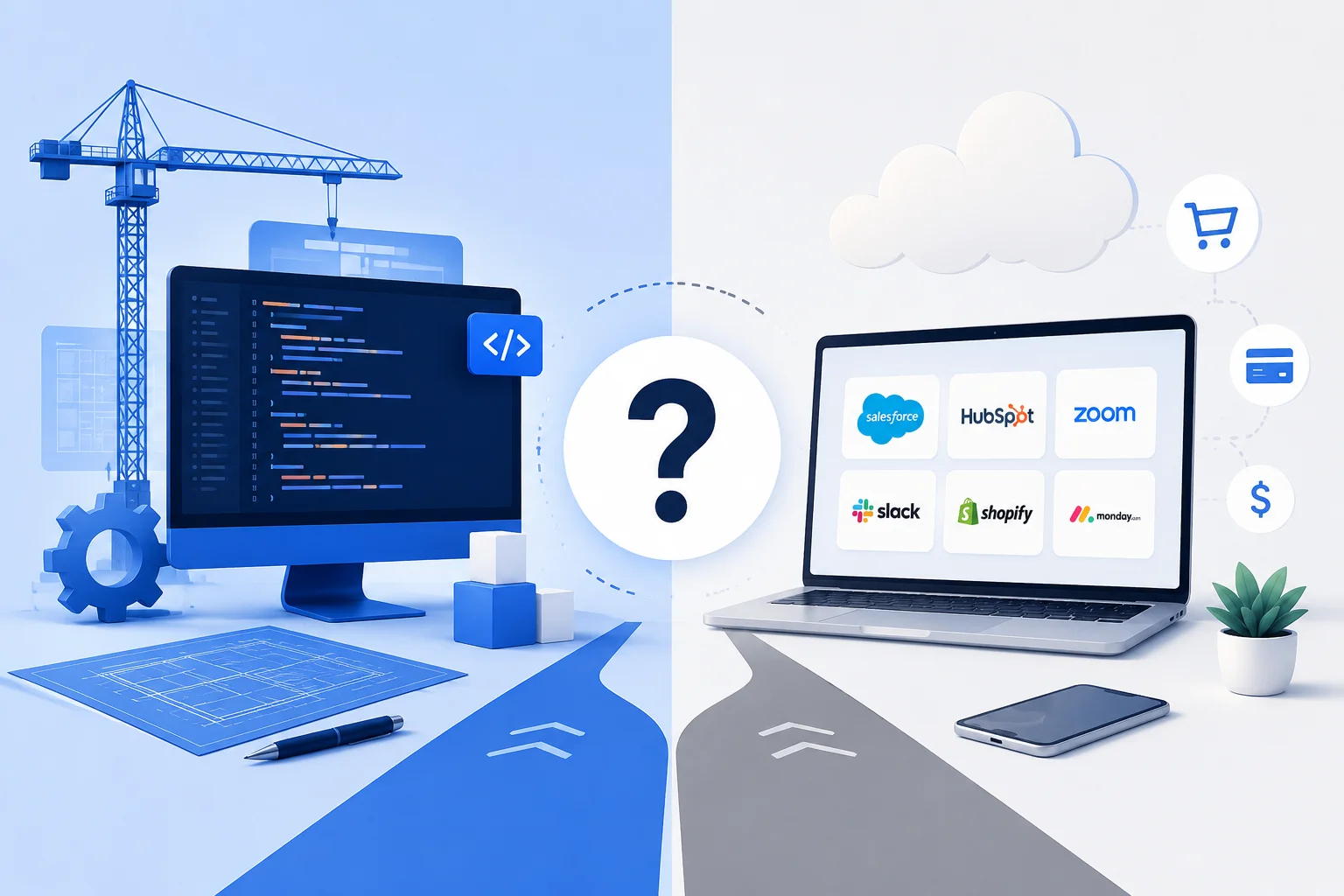
The in-house vs outsourcing software development choice trades compounding knowledge against speed and price. Fully loaded, one US developer costs roughly $200,000 a year; an equivalent outsourced engineer runs $60,000 to $140,000. In-house wins for the long-term core of your product; outsourcing wins for speed, specialized skills, and everything before product-market fit.
Most articles on this comparison are written by someone selling one side of it. We sell the outsourced side, so let us put the bias on the table and then argue against it where the numbers say so, because they often do. The honest answer for most growing companies is not a winner; it is a deliberate mix that changes as the company grows. This guide prices both options completely, including the costs each side’s salespeople leave out, and ends with the framework we use when clients ask us this exact question.
What Do In-House and Outsourcing Actually Mean?
In-house means developers on your payroll, working only on your product. Outsourcing means paying an external partner for development capacity, and it covers a spectrum rather than a single model. At one end sits project outsourcing, where a partner delivers a finished product against a specification. In the middle sit dedicated teams, which work only on your product but stay on the partner’s payroll. Closest to hiring sits staff augmentation, where external engineers join your team under your management; we covered that model’s mechanics in our guide to what staff augmentation is.
The spectrum matters because the comparison changes at each point. Project outsourcing competes with “should we build this at all in-house”; staff augmentation competes almost directly with a job posting. Through this guide, the cost figures separate those cases where the difference is material.
One market fact frames the whole decision: hiring is hard and staying hard. ManpowerGroup’s 2026 Talent Shortage survey of 39,063 employers found 72% still report difficulty filling roles, and the US Bureau of Labor Statistics projects software developer employment growing 15% from 2024 to 2034, far above the average occupation. Demand for the people you want to hire is not softening, which is precisely why the build-a-team path costs what it costs.
What Does an In-House Developer Really Cost?
A US mid-to-senior developer costs roughly $190,000 to $230,000 per year fully loaded, before you have paid for a single line of management. The arithmetic is worth showing, because the salary is only the visible layer.
Start with the BLS wage data for software developers: median pay of $133,080 as of May 2024, with senior engineers in major markets well above it. Salaries are only about 70% of compensation: the BLS Employer Costs for Employee Compensation release puts benefits at 30.1% of total compensation for private industry, which lifts a median-salary developer to roughly $190,000 in total compensation alone. Then the layers agencies never mention and job ads never show:
| Cost layer | What it includes | Typical annual impact |
|---|---|---|
| Total compensation | Salary plus benefits, taxes, insurance | ~$190K at the median |
| Recruiting | Agency fees or internal sourcing, interview hours | $15K–$40K amortized per hire |
| Equipment and tooling | Hardware, licenses, cloud and dev tools | $5K–$10K |
| Onboarding drag | 2–4 months to full productivity | Real but uncounted |
| Management | A share of an engineering lead’s attention | Grows with team size |
Frame the ranges honestly: the table’s compensation line rests on BLS data, while the lower rows reflect what we see across client teams, one firm’s market observation rather than audited benchmarks.
Two structural costs complete the picture. A hire is a commitment measured in years, so a mistake costs a severance conversation, a restart of the three-month recruiting cycle, and the morale tax in between. And a team of one is fragile: vacation, illness, or resignation stops the roadmap entirely, which is why realistic in-house planning starts at two engineers, not one, doubling every number above.
What the money buys is real and should be stated just as plainly: undivided attention, deep product knowledge that compounds every quarter, instant communication, and culture. For the system at the core of your business, those returns are frequently worth every dollar of the premium.
What Does Outsourced Development Really Cost?
Outsourced engineers cost $30 to $150 per hour depending on region and seniority, which translates to roughly $60,000 to $140,000 per year for a full-time mid-level engineer from the regions most US companies actually use, Eastern Europe and Latin America. Full regional rate tables and engagement models are in our guide to outsourcing software development; the ranges here are what we quote and see founders quoted, market observation rather than audited data.
The visible outsourced price hides its own layers, and pretending otherwise would make this comparison as dishonest as the salary-only version of hiring. Communication overhead is real: distributed work runs on writing, and a team that cannot produce clear written specifications will pay a rework tax that erases rate savings. Management does not disappear; project outsourcing shifts it to the vendor’s project manager, but staff augmentation leaves it with your lead. Time zones compress collaboration windows in the cheapest regions. Vendor risk exists: agencies have attrition and occasionally fail, which is why contract terms around replacement, notice, and code ownership matter more than rate cards.
And the quality variance is wider than in any hiring market. The best outsourced teams are indistinguishable from excellent in-house teams; the worst are cheaper per hour and ruinously expensive per outcome. The spread within any region dwarfs the spread between regions, which makes partner vetting, the subject of our guide on how to choose a software development company, the highest-return hour in the whole process.
In-House vs Outsourcing: The Full Cost Comparison
Side by side, for one developer-equivalent of capacity, using the loaded figures above:
| In-house US hire | Staff augmentation | Outsourced dedicated team / project | |
|---|---|---|---|
| Year-one cost | $210K–$270K with recruiting and setup | $60K–$140K | $80K–$250K per project scope |
| Ongoing annual | $190K–$230K | $60K–$140K | Retainer or per-project |
| Time to productive | 3–5 months (recruit + ramp) | 2–4 weeks | 2–6 weeks including scoping |
| Exit cost | Severance, restart of hiring cycle | Notice period, typically 2–4 weeks | Contract end |
| Knowledge retention | Compounds in your company | Partial; walks out unless documented | Mostly with the vendor |
| Management load on you | Full | Full | Light (vendor manages) |
| Best at | Long-term core product ownership | Fast capacity inside your process | Defined builds, full products |
The three-year view sharpens the choice. Over three years, an in-house engineer costs roughly $600,000 to $750,000 and leaves behind deep product knowledge, institutional memory, and a person who can mentor the next hire. The same three years of outsourced capacity costs roughly $200,000 to $420,000 and leaves behind whatever documentation discipline you enforced. The gap is large enough to fund an entire second product, and also large enough to be worth paying when the knowledge is the point. Neither conclusion is universal, which is why the “hides” section below matters more than the table.
There is also the mix, which is where most real companies land. A common pattern we see: a small in-house core, one or two senior engineers who own architecture and product knowledge, extended by outsourced capacity that flexes with the roadmap. Deloitte’s Global Outsourcing Survey found access to skilled talent and agility have joined cost as primary drivers of external sourcing, which matches what that pattern optimizes for: the core compounds, the flex absorbs demand spikes, and neither is asked to do the other’s job.
A Worked Example: Four Engineers of Capacity, Three Ways
Abstract ranges become a decision when you price a real scenario, so take a common one: a post-seed startup that needs roughly four engineers of capacity for the next two years.
Fully in-house, four hires cost roughly $800,000 to $950,000 per year loaded, plus $60,000 to $160,000 in recruiting to assemble, plus three to five months of calendar before the team is even complete. Two-year total: around $1.7 to $2.1 million, ending with a team that knows the product cold and a monthly burn that persists whether the roadmap needs it or not.
Fully outsourced, a dedicated four-person team runs roughly $280,000 to $560,000 per year at typical nearshore and Eastern European rates, starts inside a month, and scales down with a notice period instead of severance. Two-year total: around $560,000 to $1.1 million, ending with a shipped product and only as much retained knowledge as your documentation discipline enforced.
The mixed version, which is what we would actually recommend to this company: one senior in-house hire who owns architecture (~$230,000 to $270,000 loaded per year) plus three augmented or dedicated engineers (~$210,000 to $420,000 per year). Two-year total: around $900,000 to $1.4 million. The core compounds, the flex flexes, and at the end the company owns its knowledge without having carried four permanent salaries through the uncertain stretch. The savings against fully in-house, roughly half a million dollars, is a funded second product or a year of extra runway.
What Does the Cost Comparison Hide?
Four factors decide more outcomes than the price gap does, and each cuts in a different direction.
Speed to start. A funded roadmap waiting three to five months for hires is burning opportunity cost the spreadsheet never shows. Outsourcing’s two-to-four-week start is frequently worth more than its rate advantage, and this single factor explains most post-funding outsourcing decisions.
Knowledge compounding. Every quarter an in-house engineer works, your codebase becomes better understood, decisions get faster, and onboarding the next person gets cheaper. Outsourced knowledge compounds at the vendor. Documentation narrows the gap but does not close it, and companies that outsource their core product for five years often discover they no longer fully understand what they own.
Control and course-changing. In-house teams turn on a decision made at lunch. Project outsourcing turns through change requests, and a product still searching for fit changes direction constantly, which is why pre-product-market-fit companies feel friction with fixed-scope contracts and why staff augmentation or dedicated teams fit that stage better.
Fragility profiles. In-house risk concentrates in individuals: one resignation can stall a small team for a quarter. Outsourced risk concentrates in the relationship: a bad vendor fails wholesale. You choose which failure mode you can better survive, and contracts, documentation, and team size are how each is hedged.
Security and IP surface. An in-house team keeps code, credentials, and data inside one legal entity by default. Outsourcing extends that surface to another company, which is manageable, the whole industry runs on NDAs, IP assignment clauses, and access controls, but only when the contract claims it explicitly and someone verifies the practices behind it. The risk is not outsourcing itself; it is outsourcing on a handshake, and the difference between the two is a week of legal work at the start of the engagement.
When Should You Build In-House?
Hire when the work is permanent, central, and worth compounding. The clear signals: the system is the company’s core product with years of roadmap ahead; product decisions and engineering decisions are inseparable, so the builder must sit inside every conversation; you have the management capacity and the twelve-plus-month runway a team build requires; and the mission can attract engineers, because in a market where 72% of employers struggle to fill roles, your offer competes with everyone else’s.
The failure mode to avoid: hiring for a spike. Building a permanent team for a temporary workload converts a six-month need into a multi-year obligation, and unwinding it costs money and morale. If the honest forecast says the work crests and recedes, rent the crest. The reverse discipline also applies: when a “temporary” outsourced arrangement has quietly run three years on core product work, the numbers have been telling you to hire for at least two of them.
When Should You Outsource Development?
Outsource when speed, specialized skills, or capital efficiency dominate. The clear signals: you need to ship before a hiring cycle could even complete; the skill is specialized and temporary, an AI integration, a compliance build, a platform migration, where buying expertise for six months beats growing it for two years; you are pre-product-market-fit and capital efficiency decides how many experiments your runway can fund; or the work is a defined project with a real endpoint rather than an open-ended roadmap, where a permanent team would outlive its own purpose.
The failure mode on this side: outsourcing the thing you should own. A company whose entire product lives with a vendor, with no internal person who can evaluate the work, has outsourced its judgment along with its code. Keep or hire at least one technical voice that answers to you alone, whatever the mix; every healthy outsourcing relationship we have runs through one.
How Do You Decide? A Step-by-Step Framework
Six questions turn the comparison into a decision:
- Is this work permanent or a phase? Permanent core work justifies hiring’s premium; phases and projects favor renting. Answer per workstream, not for the company as a whole.
- Can you afford to wait for a hire? Price the three-to-five-month recruiting-and-ramp gap against your roadmap. If the delay costs more than a year of the rate difference, the spreadsheet has answered.
- Do you have management to spend? In-house teams and augmented engineers both consume your leadership’s attention. If nobody on your side can direct engineers, project-style outsourcing with vendor management is the only honest option.
- Run the three-year loaded math. Fully loaded compensation, recruiting, and fragility on one side; rates, management overhead, and documentation discipline on the other, at your projected team size, not today’s.
- Decide what must compound internally. Name the one or two systems whose knowledge the company must own forever. Those anchor the in-house core, or the first future hires. Everything else is candidate flex capacity.
- Pilot the mix small. One hire plus two augmented engineers, or one outsourced project beside an in-house core. Ninety days of evidence beats any framework, including this one.
Frequently Asked Questions
Is it cheaper to outsource software development or hire in-house?
Per unit of capacity, outsourcing is substantially cheaper: $60,000 to $140,000 per year for a full-time outsourced engineer against roughly $190,000 to $230,000 fully loaded for a US hire. The premium buys compounding product knowledge, undivided attention, and control. Cheapest overall depends on duration: long-term core work narrows the gap through retention; short-term work widens it.
How much does an in-house software developer cost per year?
Around $190,000 to $230,000 fully loaded for a US mid-to-senior developer: BLS puts median salary at $133,080, benefits add roughly 43% on top of wages per its employer-cost data, and recruiting, equipment, and tooling stack further. Senior engineers in major markets run well past this, and a realistic minimum team of two doubles everything.
How much does outsourcing software development cost?
Mid-level engineers run $30 to $70 per hour from Eastern Europe and Latin America, $75 to $150 from the US, roughly $60,000 to $140,000 per engineer-year full time. Project outsourcing prices per scope instead, commonly $80,000 to $250,000 for a serious build. Rates below these bands usually signal quality or communication costs that surface later.
What are the risks of outsourcing software development?
The big four: quality variance across vendors, knowledge accumulating outside your company, communication overhead taxing distributed work, and vendor dependence if the relationship fails. All four are managed the same way: rigorous partner vetting, contractual code ownership and documentation requirements, at least one internal technical voice, and starting with a small scoped engagement before committing the roadmap.
Can I mix in-house and outsourced development?
Yes, and the mix is the most common end state we see. The standard pattern keeps a small in-house core owning architecture and product knowledge, extended by outsourced or augmented capacity that flexes with the roadmap. The core compounds what must be owned; the flex absorbs spikes without permanent payroll. The mix also shifts over time, typically in-sourcing more as the company matures.
When should a startup hire its first in-house developer?
When two things are true: the product has enough validation that the core system will exist in three years, and there is a technical leadership gap no vendor should fill, someone to own architecture, evaluate external work, and sit inside product decisions. Before that point, capital efficiency usually favors outsourced builds; after it, the first hire anchors everything else.
Does outsourcing mean lower quality?
No; it means wider variance. Top outsourced teams match excellent in-house teams, and the worst are far below any hiring bar, with price a poor predictor in either direction. Quality tracks the partner’s engineering discipline and your own clarity of requirements. Vet portfolios and references, start small, and judge shipped work rather than rate cards.
How do I keep control and IP when outsourcing?
Contract for it explicitly: full IP assignment on creation, code in repositories you own from day one, documentation as a deliverable, and defined replacement and exit terms. Operationally, keep one internal technical reviewer, require written decision records, and hold deploy keys and accounts in your name. Control lost to a vendor is almost always control that was never contractually claimed.
Conclusion
Generic comparisons end where your roadmap begins, and the spreadsheet takes an afternoon, not a quarter. Bring us your workstreams, timeline, and budget, and we will run the loaded three-year math honestly, including the workstreams where our advice is “hire, and here is the job description.” Book a free consultation and leave with a staffing mix instead of a sales pitch.