How much does it cost to build custom software? Everyone asks. Nobody likes the answer, because the answer is “it depends.” And “it depends” does not help when you are sitting across from your CFO trying to justify a six-figure line item.
So let me skip the hedging and give you real numbers.
Most custom software projects in 2026 land between $30,000 and $300,000. A basic internal tool or MVP starts around $15,000 to $40,000. A proper business application with multiple user types, integrations, and custom logic runs $50,000 to $150,000. Enterprise systems with compliance requirements, real-time processing, or serious security needs push past $300,000 and can clear $500,000.
Those are wide ranges. This guide explains why they are wide, what actually pushes your project toward one end or the other, and what expenses most pricing guides conveniently leave out.
Quick Answer: Custom Software Development Cost in 2026
The cost to build custom software in 2026 goes from $15,000 for simple tools to $500,000 or more for enterprise platforms. Clutch’s 2026 pricing data puts the average custom software project at roughly $132,000 with a 13-month delivery timeline. Most small and mid-size projects fall between $30,000 and $200,000. What determines where you land: project complexity, feature count, team location, how polished the design needs to be, how many third-party systems you need to connect to, and whether you are in a regulated industry. Then add 15 to 25% of the build cost per year for maintenance.
Custom Software Cost by Project Size
The simplest way to think about pricing is by project size.
Simple applications ($15,000 to $40,000). A basic dashboard, a customer portal, a data collection tool with a database behind it. Nothing fancy, but it solves a problem that off-the-shelf software does not quite handle. Two to four months to build. The kind of project where a small business owner says “I just need a tool that does this one thing properly.”
Mid-complexity applications ($50,000 to $150,000). This is where most custom projects live. Multiple user roles, business logic that is specific to how you operate, payment processing, third-party integrations, an admin panel, responsive design. Three to six months. Think of a logistics company that needs a shipment tracking platform, or a staffing agency building an on-demand marketplace. Most of the projects in our portfolio sit in this range.
Complex platforms ($150,000 to $300,000). Real-time data processing, AI features, multi-tenant architecture, heavy analytics, integration work with legacy systems. Six to twelve months. A fintech platform handling live market feeds. A healthcare system that needs HIPAA compliance baked into every layer.
Enterprise-grade systems ($300,000 to $500,000+). Mission-critical platforms where downtime is not an option. High availability, advanced security, regulatory compliance, multiple integrations, and enough concurrent users that architecture decisions actually matter. Nine to eighteen months. Banks, insurance companies, large logistics operations.
We have built across this full range at SoftwareOrbits. FloCargo and ShiftTake sit in the mid-complexity tier. TheFlowShark and Deuce Data are on the complex end, with real-time data streaming and high-frequency updates.
What Actually Drives the Cost Up or Down
The price is not arbitrary. A few specific things move the number, and understanding them saves you from sticker shock later.
Features and Scope
This one is obvious, but people still underestimate it. Every feature needs to be designed, built, tested, and maintained forever after. A login screen with email authentication is cheap. A login screen with social auth, biometric login, multi-factor authentication, and role-based permissions is not cheap. Multiply that difference across 30 features and you understand why scope is the biggest cost driver.
The move that saves the most money: build an MVP first. Ship the smallest version that actually works, learn what your users care about, then invest in the features that matter. Half the features on most initial wish lists turn out to be unnecessary once real people start using the product.
Integrations
Most custom software needs to connect to other things. Payment gateways, email services, CRMs, accounting software, shipping APIs. Each connection adds work for implementation, testing, error handling, and ongoing maintenance when those external services update their APIs (and they will).
A typical business app talks to 6 to 12 outside services. Each one can add $2,000 to $15,000 to the budget depending on how straightforward or painful the API is to work with.
Design
There is a real cost difference between picking a pre-built component library and designing a fully custom interface from scratch. For an internal tool your own team uses, a clean off-the-shelf design is fine. For a customer-facing product where the experience is the product, plan to spend 15 to 25% of the total budget on design. It pays for itself in adoption and retention.
Where Your Team Is Based
Geography is one of the biggest levers you have on cost. Senior developers in North America charge $150 to $250 per hour. Western Europe runs $100 to $180. Eastern Europe, $60 to $120. South Asia, $25 to $60.
A $100,000 project with a US team might cost $50,000 to $70,000 with a skilled Eastern European team. But cheaper rates do not always mean cheaper projects. Communication gaps, time zone headaches, and quality inconsistencies can eat the savings. The rate matters less than the outcome.
Compliance
If your software touches health records, financial data, or European user data, compliance is not something you add at the end. HIPAA, PCI-DSS, GDPR — these affect how the system is designed from day one. Architecture, encryption, audit logging, testing, documentation. Add 20 to 40% to your baseline budget for regulated industries.
Timeline Pressure
Rushing costs money. Compressing a four-month project into six weeks means putting more developers on it simultaneously, which means more coordination overhead, more merge conflicts, more things falling through the cracks. Rough rule: cutting a timeline in half adds at least 50% to the cost.
The Expenses Nobody Tells You About
The build price is the number everyone focuses on. It is not the whole number.
Maintenance: 15 to 25% Per Year, Every Year
Software does not stay done. Libraries get deprecated. Security vulnerabilities get discovered. Payment APIs change their behavior. Apple and Google release new OS versions that break something. Plan for 15 to 25% of the original build cost annually, just to keep things working.
On a $100,000 build, that is $15,000 to $25,000 per year. Not optional. Software you do not maintain slowly rots until something breaks at the worst possible time.
Hosting
Your software has to run somewhere. Cloud hosting on AWS, Azure, or Google Cloud runs $2,000 to $10,000 per year for small and mid-size apps. It scales up from there as your user base grows. Good architecture plans for this early so costs track actual usage instead of worst-case guesses.
Discovery
A proper discovery phase — requirements, architecture planning, wireframes, scoping — costs $5,000 to $15,000. Some businesses skip it to save money upfront. That almost always backfires. Skipping $10,000 in discovery regularly leads to $30,000 to $50,000 in rework because the team built the wrong thing.
At SoftwareOrbits, our custom software development process starts with discovery on every project. Not because we like extra process, but because we have seen what happens when it gets skipped.
Training
Great software that nobody uses is just an expensive server bill. Budget for training, onboarding documentation, and the change management work it takes to get people off their spreadsheets and actually using the new system. This gets overlooked constantly.
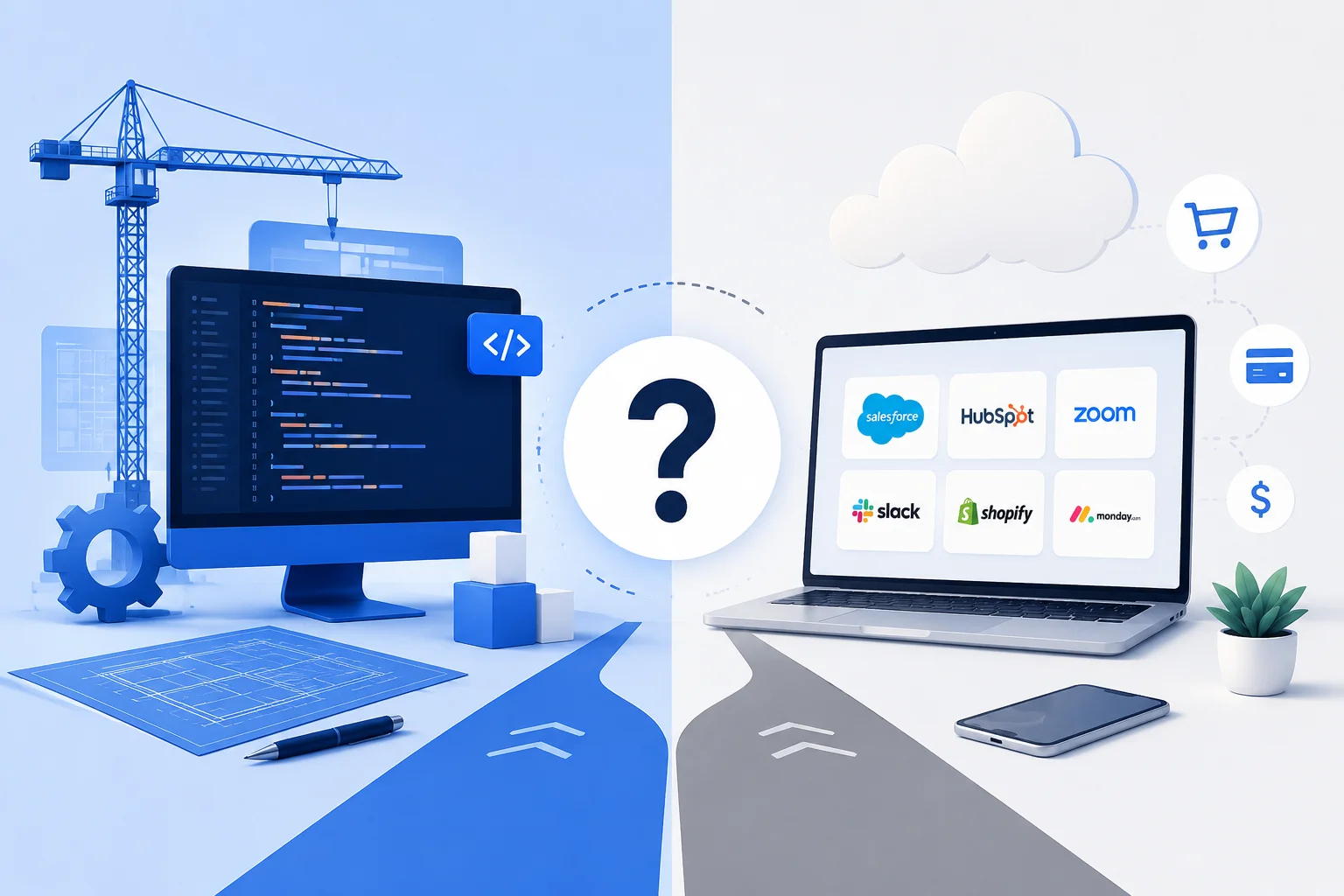
When Is Custom Worth It Over Off-the-Shelf?
Custom software costs more upfront than a SaaS subscription. That is a fact. The question is whether the upfront cost is worth it for your situation.
Your workflow is your edge. If the way you operate is what makes you different from competitors, a generic tool cannot capture that. Your competitor using the same SaaS platform has access to the same features you do. That is not a competitive advantage.
You are spending more time on workarounds than actual work. When your team has built an elaborate system of Zapier hacks, Google Sheets, and manual processes to compensate for what the software cannot do, the cost of those workarounds often exceeds the cost of building something purpose-built. You are already paying for custom software — just inefficiently.
You need control over your data. SaaS products store your data on their servers, on their terms. If data ownership, security control, or hosting flexibility matters to your business, custom gives you that.
The problem is generic? Buy off-the-shelf. Email marketing, basic accounting, HR, project management — good tools already exist. Do not build custom versions of commodity software. That is a waste of money.
Not sure? Start with an MVP. Most MVPs cost $25,000 to $80,000 and take 2 to 4 months. Enough to learn whether the market wants what you are building before you commit to the full investment.
Getting More Value Without Spending More Money
A few things consistently separate projects that deliver great returns from projects that become expensive disappointments.
Start with an MVP. Build the smallest useful version. Ship it. Watch what people actually do with it. Then invest in the features that matter based on evidence, not guesses. This one decision prevents more wasted money than anything else on this list.
Do not skip discovery. A $10,000 discovery phase that gets requirements right saves $30,000 or more in rework down the line. We have watched this happen enough times that we do not start projects without it anymore.
Pick the right contract structure. Fixed-price works for well-scoped projects. Time-and-materials works for products that will evolve during development. Using the wrong model for your project type is one of the most common reasons budgets blow up.
Be honest about what belongs in version one. Not every feature needs to ship at launch. A clear MVP with a phased roadmap keeps initial costs down and gives you room to adapt as you learn.
Budget for what happens after launch. Maintenance, hosting, at least one round of improvements based on user feedback. Projects that only budget for the build and ignore everything after consistently end up in trouble 6 to 12 months later.
Evaluate the team, not just the quote. The cheapest proposal is rarely the best value. A development partner with a clear process, honest communication, relevant experience, and pricing that actually includes everything will cost more per hour and less per outcome.
Frequently Asked Questions (FAQ)
How much does it cost to build custom software in 2026?
Most projects cost between $30,000 and $300,000. Simple tools start at $15,000 to $40,000. Mid-complexity apps run $50,000 to $150,000. Complex platforms with real-time data or compliance needs go past $200,000. The average across the industry is about $132,000 according to 2026 data.
How much does an MVP cost?
Typically $25,000 to $80,000, taking 2 to 4 months. You get the core features needed to test your idea with real users before committing to a bigger build.
What does annual maintenance cost?
Budget 15 to 25% of what you spent building it, every year. A $100,000 build means $15,000 to $25,000 annually for updates, bug fixes, security patches, and keeping everything compatible. Skip this and things break.
Is custom software cheaper than SaaS long-term?
It can be. A SaaS tool at $50 per user per month for 50 users costs $30,000 a year, or $150,000 over five years. A custom build at $100,000 plus $20,000 annual maintenance totals $200,000 over the same period, but you own it, pay no per-user fees, and it is built for exactly how your business works.
What makes custom software expensive?
Feature count and complexity, number of integrations, compliance requirements (HIPAA, GDPR, PCI-DSS), custom design work, and timeline pressure. Each of these can shift the total by 20 to 50%.
How long does a custom software project take?
Longer than most people expect. Simple tools take 2 to 4 months. Mid-complexity apps: 4 to 8 months. Enterprise platforms: 9 to 18 months. The industry average is 13 months.
Freelancers or a development company?
Freelancers are fine for small, well-scoped work. Once a project has multiple moving parts — and needs QA, project management, DevOps, and somebody to call six months after launch — a company is the safer bet.
How do I avoid going over budget?
Do proper discovery. Define your MVP clearly. Match the contract model to your project type. Budget for maintenance from day one. And choose a partner who communicates well, because most budget overruns come from misunderstandings, not technical problems.
Conclusion
Building custom software in 2026 is not cheap. But when the alternative is running your business on spreadsheets and duct-tape workarounds, or watching SaaS fees compound year after year for a tool that never quite does what you need, the math changes.
The pattern we keep seeing with projects that go well: they invest in discovery upfront, they launch a focused MVP instead of trying to build everything at once, and they budget for what happens after launch — not just the build itself. The ones that go sideways usually skipped one of those.
If you are working through the numbers for a custom software project, we are happy to talk through it honestly. Our custom software development team at SoftwareOrbits has built platforms across fintech, logistics, healthcare, staffing, and sports analytics. Every engagement starts with a discovery process that gives you real pricing before anyone writes code. Reach out for a free consultation and we will give you a straight answer.